Race Report: The Atlas Mountain Race
A report on the Atlas Mountain Race, a 1,440-kilometre race held in February 2026 between Beni Mellal and Essaouira in Morocco. This edition was marked by challenging weather conditions from the start, with torrential rain followed by sub-freezing temperatures and high winds. 36 hours of hell before finding a bit more peace of mind on the beautiful trails of Morocco’s Anti-Atlas. Pierre embarks us on this eventful, mentally challenging edition, which taught him just how much the body and mind can surprise you on these long-distance bike races.
Departure from Beni Mellal: Welcome to Hell
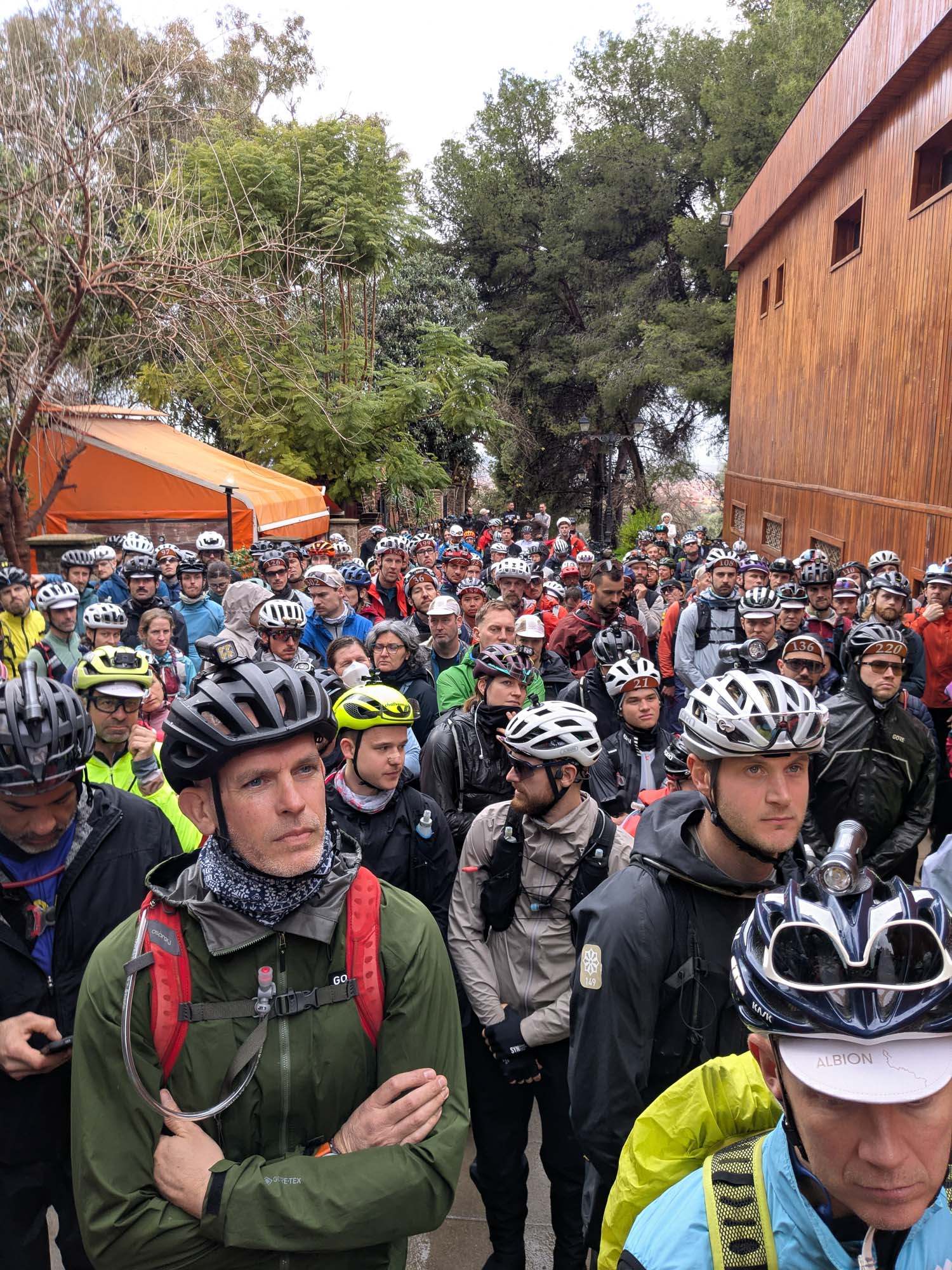
Around 4:30pm in the park above Beni Mellal, the tension is palpable. And it’s not just due to the often tense atmosphere of the moments leading up to the start, which is scheduled in half an hour.
The weather forecast is dreadful. Rain and cold are predicted from the very start of the race. Above the mountain range towering over the city, the sky is charcoal grey and clouds are gathering fast. Something is brewing.
Over the past month, Morocco has experienced such heavy rainfall that it has brought an end to seven years of drought. The rivers are swollen, and the High Atlas Mountains are covered in snow. A godsend for Morocco and the upcoming harvests. A real blow for the 280 participants in the Atlas Mountain Race.
The first 270 kilometres planned by Nelson Trees, the race director of Mountain Races, which were supposed to send us wading through the deep and spectacular M’Goun Gorges, have been rerouted. There’s too much water in the gorges, making them impassable. The 270 kilometres of trails have turned into 360 kilometres of tarmac. We’ll be passing along mountain roads and through remote villages, taking a big detour to the east to reach CP1 in Boutharar at kilometre 360 and the originally planned route. “Easy peasy,” we tell ourselves—well, at least for the French born in the ’80s. Swapping trails for tarmac means we’ll move faster. We’ll see more of the countryside. “It’s a bonus, awesome,” I even heard someone say. Yeah. Not sure the guy was quite as thrilled after the downpour.
For the past few days, everyone’s been on high alert. We’ve received several notifications of route changes due to flooding, road closures, and impassable sections. An hour before the start, Nelson confesses to me that the race came close to being cancelled altogether.
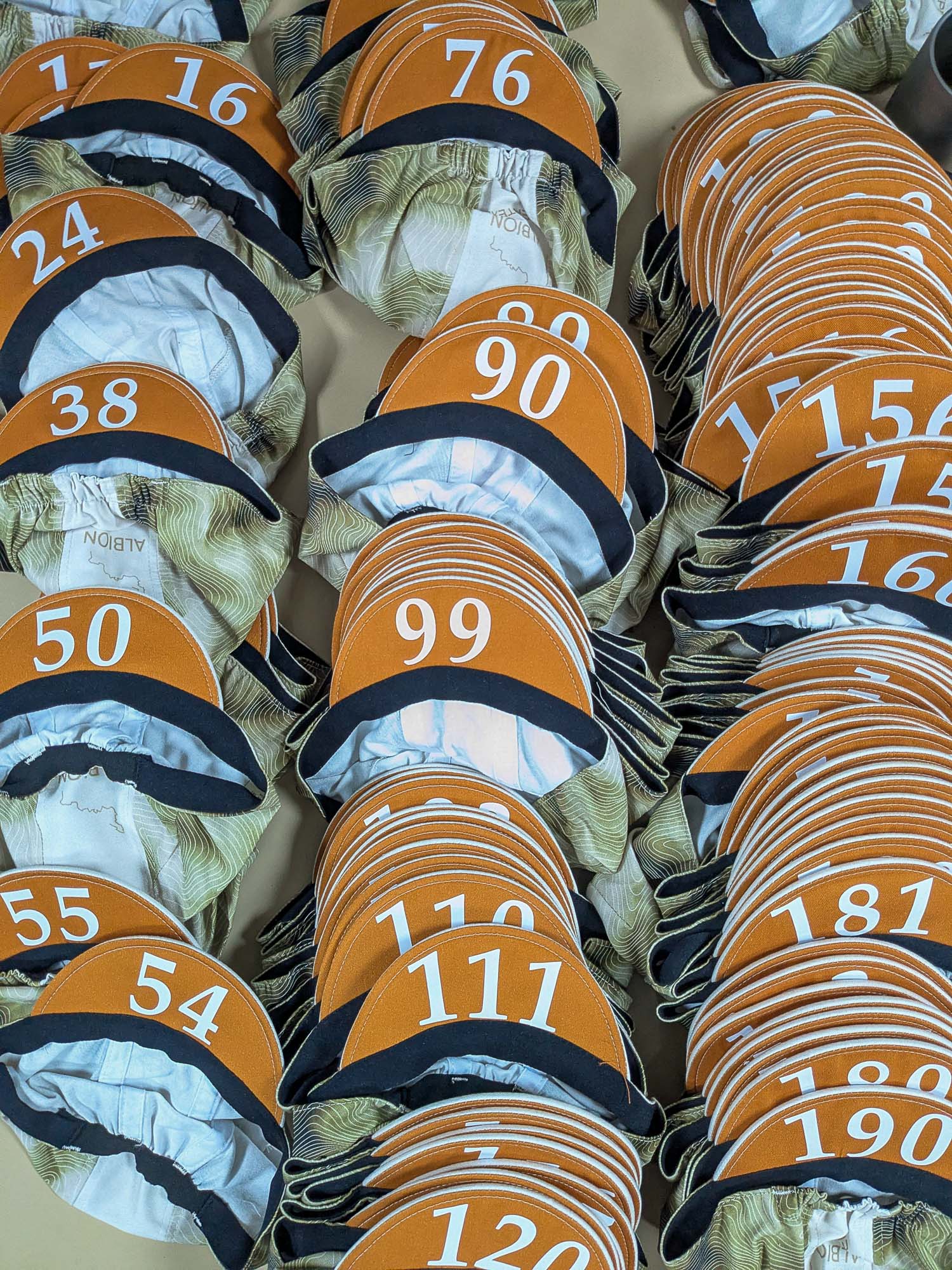
RACE RULES
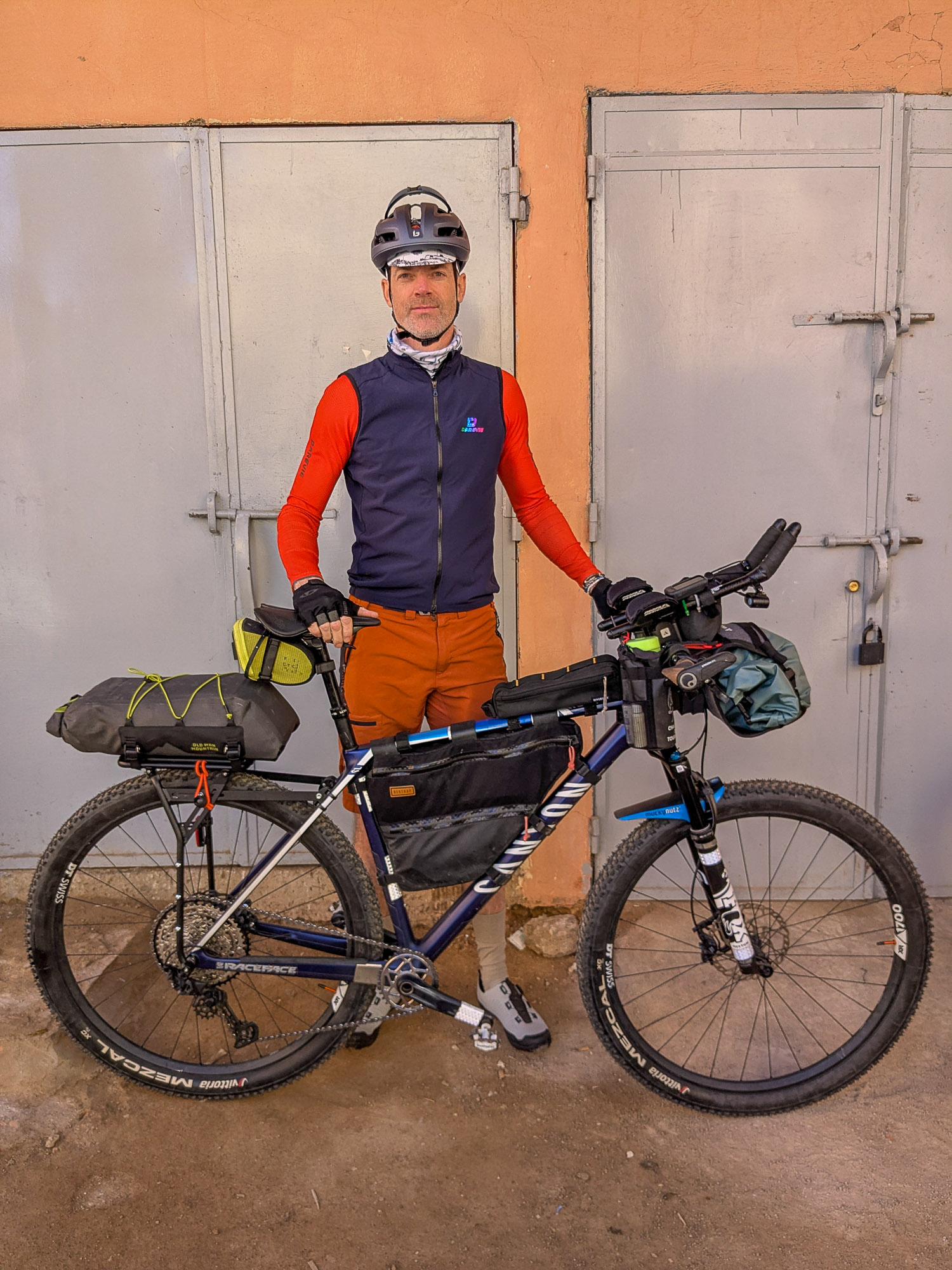
The Atlas Mountain Race is a single-stage, unsupported, ultra-distance bikepacking race through the Moroccan mountains. It connects Beni-Mellal to Essaouira over approximately 1,440 kilometres with 25,000 metres of elevation gain. The route mainly follows trails, mule tracks, and village roads, with very little in the way of paved surfaces.
Participants can ride day and night; the clock never stops, and no outside support or aid is provided, except at a few key points, such as the three checkpoints (CPs), where food is served to cyclists who want to eat. Outside the CPs, each rider is entirely self-sufficient for food, lodging, repairs, and navigation, in conditions that are sometimes extreme and very isolated. The time limit is around 8 days, which requires long days on the bike (180 kilometres per 24 hours, on average) and excellent pacing.
In the park, however, as the time for departure approaches, the 280 cyclists are ready. The bikes are still gleaming, the panniers are clean, and their faces are focused. But the fluorescent rain jackets are already on, as are gloves and neoprene overshoes. It’s started to drizzle—that kind of thick Breton drizzle that looks harmless but soaks you through in fifteen minutes if you don’t cover yourself with rain gear. There are more furrowed brows than smiles in the crowd.
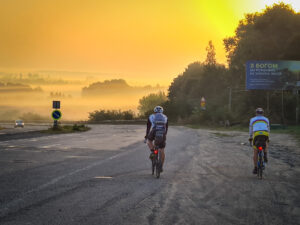
5pm. It’s time. At “3, 2, 1, go!” there’s little enthusiasm, almost no collective cheer. We push through the small crowd that’s come to support us and watch us disappear into the mountains. The climb starts right away on wet asphalt. Moments later, the lead group is already a few turns ahead; I won’t see them again. The bulk of the pack slowly stretches out into a long, colourful snake, each rider finding their own pace.
Barely five hours later, in the dead of night, I find myself with 15 other competitors in the barn/grocery store/tea bar of the small mountain village of Boutferda, at kilometre 90, 1,500 metres above sea level. We’re all huddled around a butane stove sitting in a puddle of water, on which 10 pairs of soggy gloves, piled high, are dripping and melting into wisps of steam. We order litres of scalding hot tea.
We’ve just been through hell.
At the top of the first pass, at an altitude of about 1,900 metres—20 kilometres and 1,200 metres of elevation gain after the start—we found ourselves in thick fog. The temperature dropped suddenly, and it started raining hard. A downpour. For over an hour. As night fell, I saw the mountain spewing torrents of mud. Rocks the size of footballs tumbled down the slopes and covered the road. Through the hood of my jacket, I could hear the sound of water—bubbling, rushing. My waterproof gloves quickly filled with water by capillarity. I could no longer feel my fingers. On the hairpin bends clinging to the mountain, we crossed raging torrents blindly, hoping not to hit a rock in the middle.
In survival mode, soaked, frozen, and dazed, many of us stay in this heated shelter, kept open by adorable Moroccans busy heating water and serving us tea. Outside, the rain has stopped. The temperature has dropped another notch. Everyone’s huddled around makeshift fires. We’re brought metal basins filled with glowing embers to dry our shoes. The storm has thrown us off course. As some attempt to head out to continue the journey, others arrive, frozen but happy to find tea and a blazing stove.
In Boutferda, it’s kilometre 90. I’ve been here since 11:30pm. That’s three hours. I’m wasting a lot of time. Normally, I should be much further along the trail. But up ahead lies a 2,600 metre pass, followed by a high plateau to cross in sub-freezing temperatures. It’s impossible to carry on with my clothes soaked through with sweat and rain. I remember being scared at that moment—of hypothermia, of the elements. I wait for my gear to dry a bit before setting off again around 4am. At the nearby barn/convenience store, open all night, I buy some fleece gloves and a pair of extra-large dishwashing gloves so I can get through the night and replace my still-soaked gloves. Outside, my GPS reads a temperature of -6°C. Ouch.

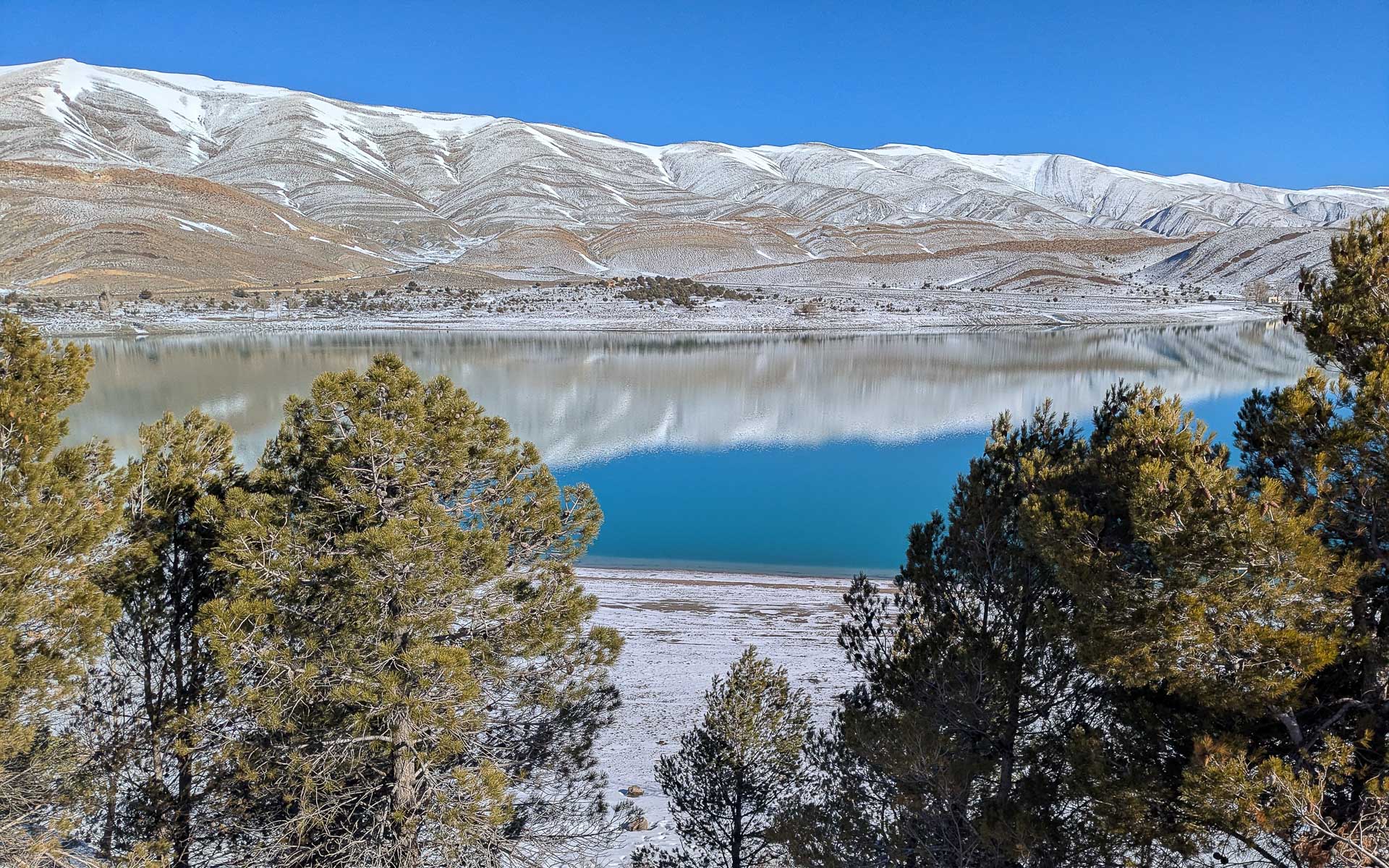
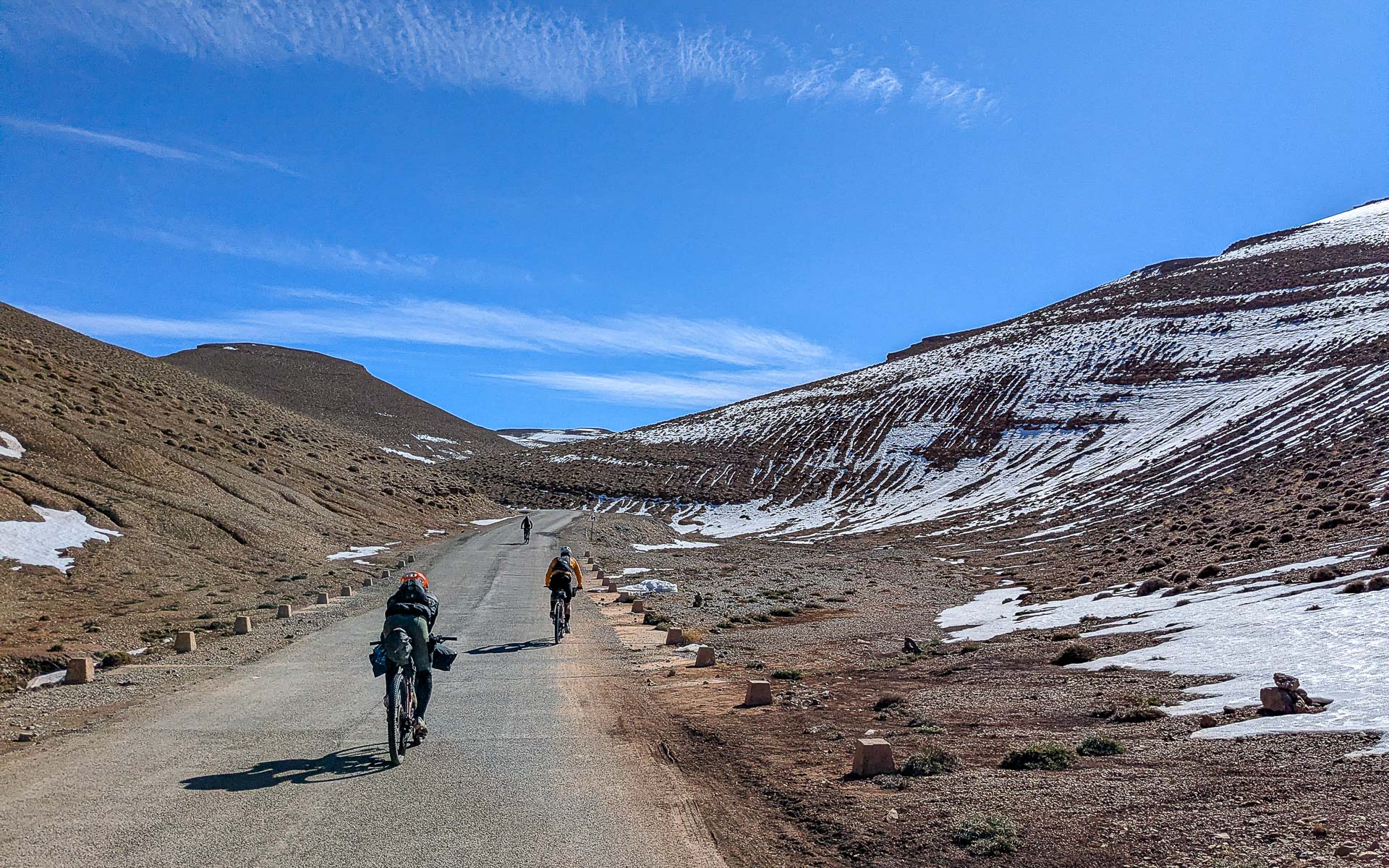
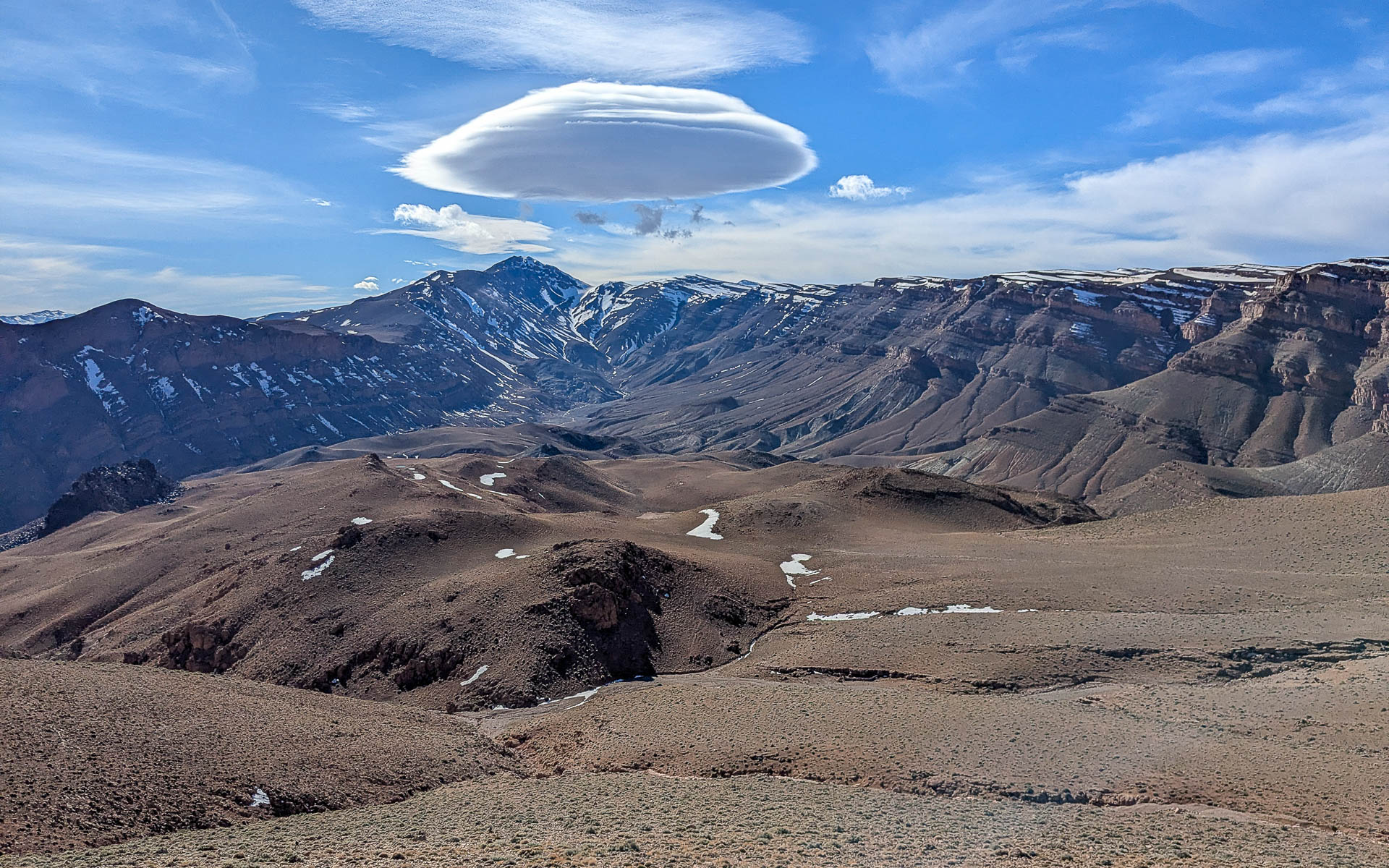
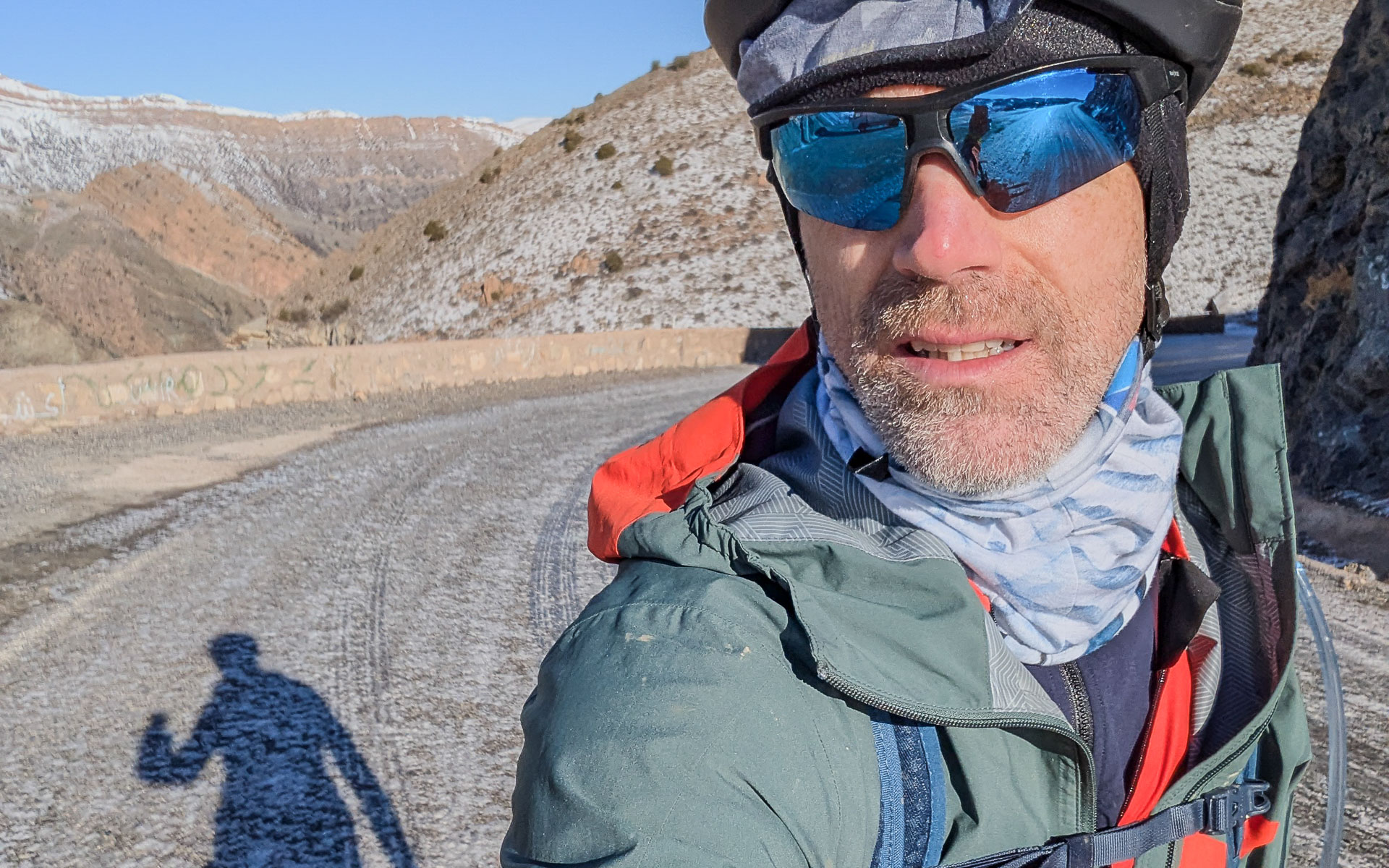
I’m fine if I keep riding. I have to keep up the pace, never stop. When dawn breaks, around 8am, I discover a frozen landscape, with layers of rock dusted with snow. The road has vanished beneath a crust of ice several centimetres thick. Gravel helps keep me from slipping too much. I stop at a roadside restaurant at the entrance to Imilchil, kilometre 167, at an altitude of 2,200 metres, where I refuel with an omelette and several glasses of sweet tea. All day long, I ride in a state of extreme fatigue through stunning landscapes, crossing high plateaus, riding alongside rivers with the wind at my back, and crossing the Tizi Tigherrhouzine Pass at an altitude of 2,645 metres. When we pass other participants, we chat a bit, but everyone is tense, stressed, and behind schedule.
In the evening, I reach the village of Tamatouchte at the bottom of a valley, at the 250-kilometre mark, where I find a small place to stay. I sleep for 7 hours straight.
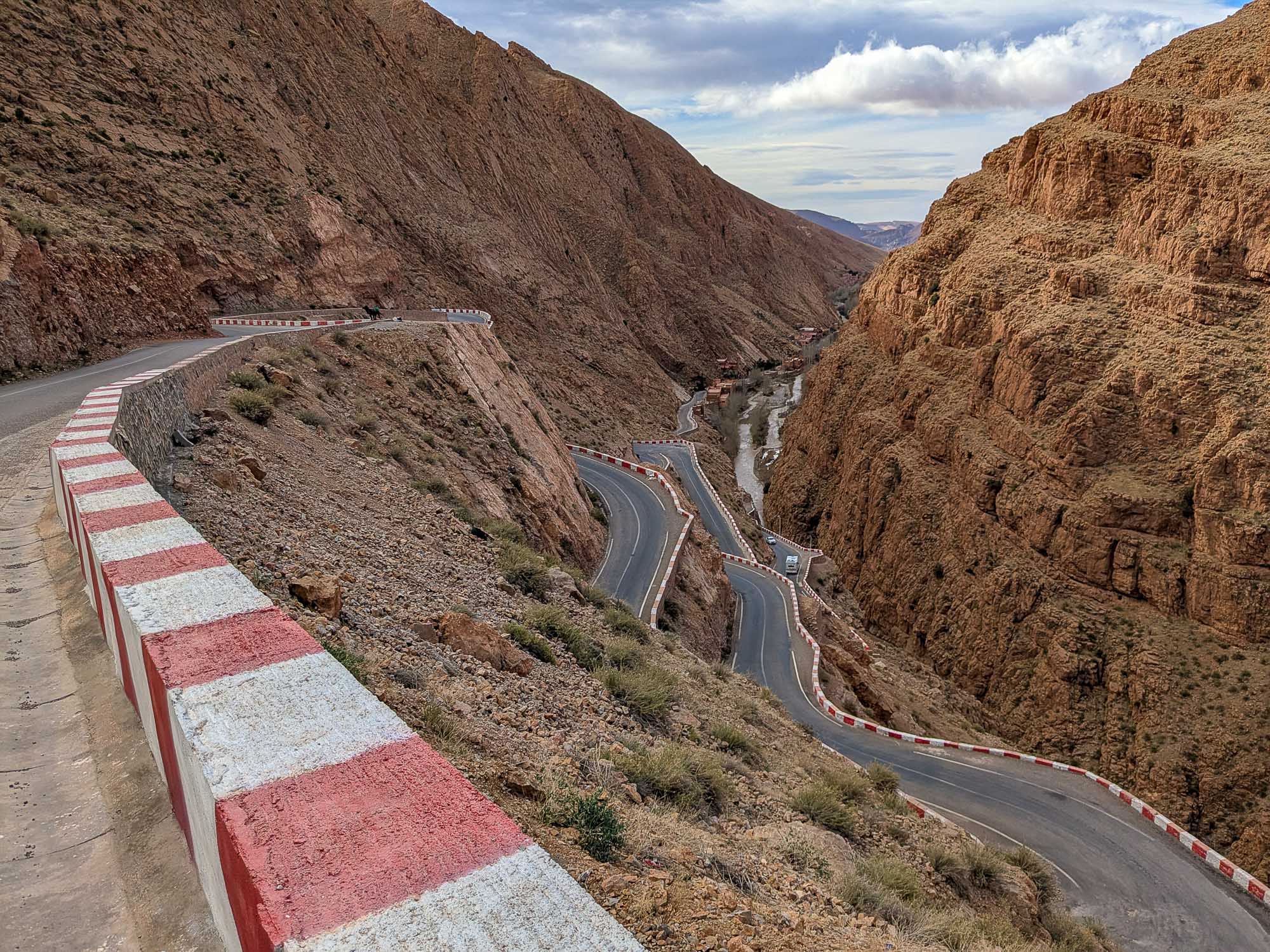
At 3:30 in the morning, the roof of my room creaks under the gusts of wind sweeping through the High Atlas. Sustained storm force winds of 120 km/h. Along with other participants, we stumble along, pushing our bikes for four hours in the dead of night, climbing 800 metres of elevation gain up a pass at over 2,600 metres: the Tizi n’Uguent Zegsaoun. Holding my bike by the handlebars, it flaps like a flag. I didn’t come here to fly a kite; I stay focused on the “biking”. But it’s rough. We’re constantly being pelted by rocks and sand torn from the mountain. My helmet still bears the marks of rock impacts. I’ve never experienced anything like it. Several riders find themselves pinned against the road’s guardrail, trapped by their bikes. Others have their bikes ripped from their hands, sliding across the road like disjointed crabs. Some even turn back. Step by step, with Erin and Jono from New York, we climb in the dark, leaning forward and following the white centre line of the road like a lifeline. On the other side of the pass, the wind drops suddenly. We race on without looking back, hoping we’re done with the raging elements. It’s starting to be a lot—too much—in barely 36 hours. I follow a winding stretch of asphalt for dozens of kilometres, weaving through the spectacular Dades Gorges, before finally reaching the first trail of the race. Only 12 kilometres, but I manage to fall on my arse nonetheless.
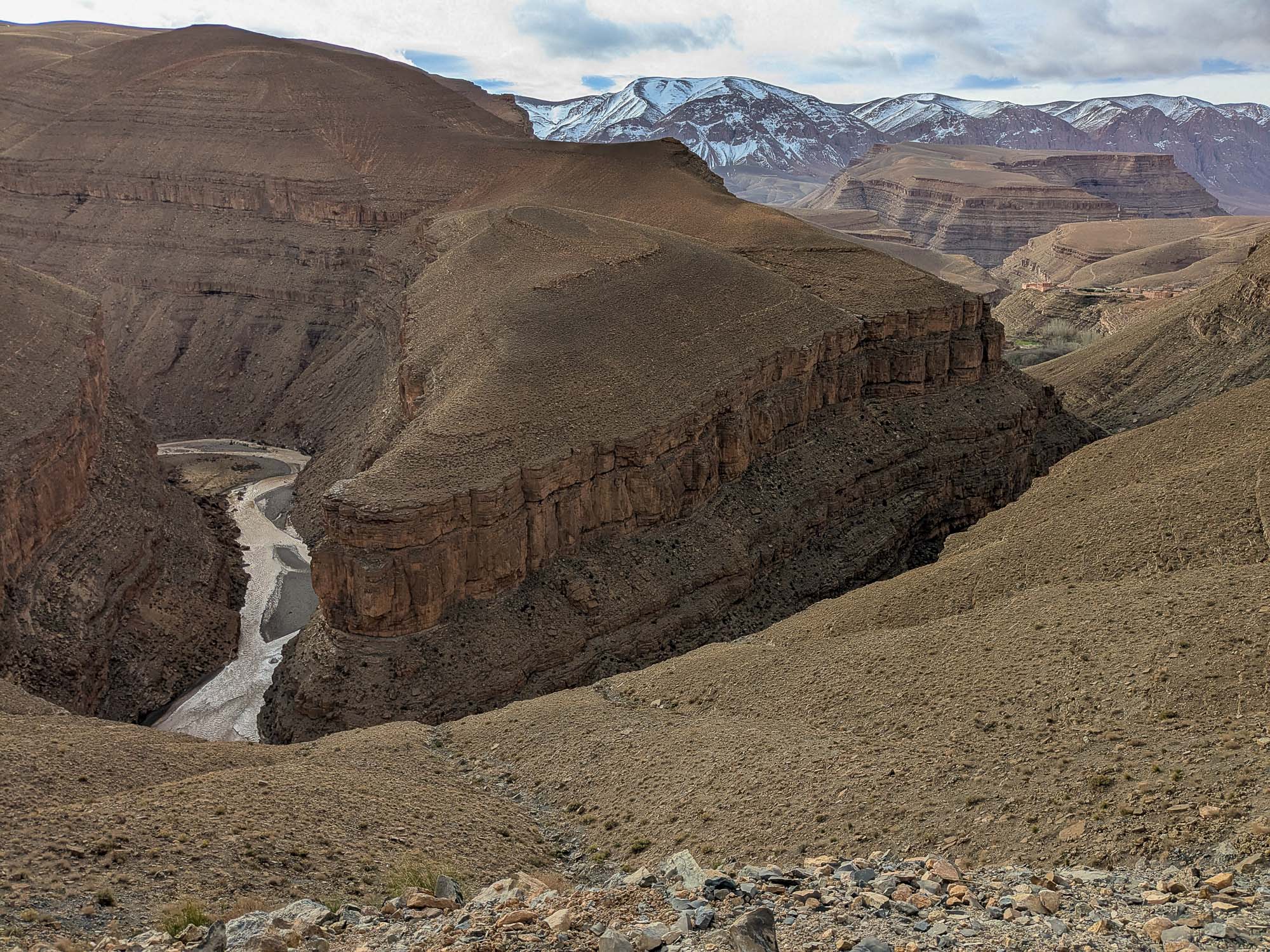

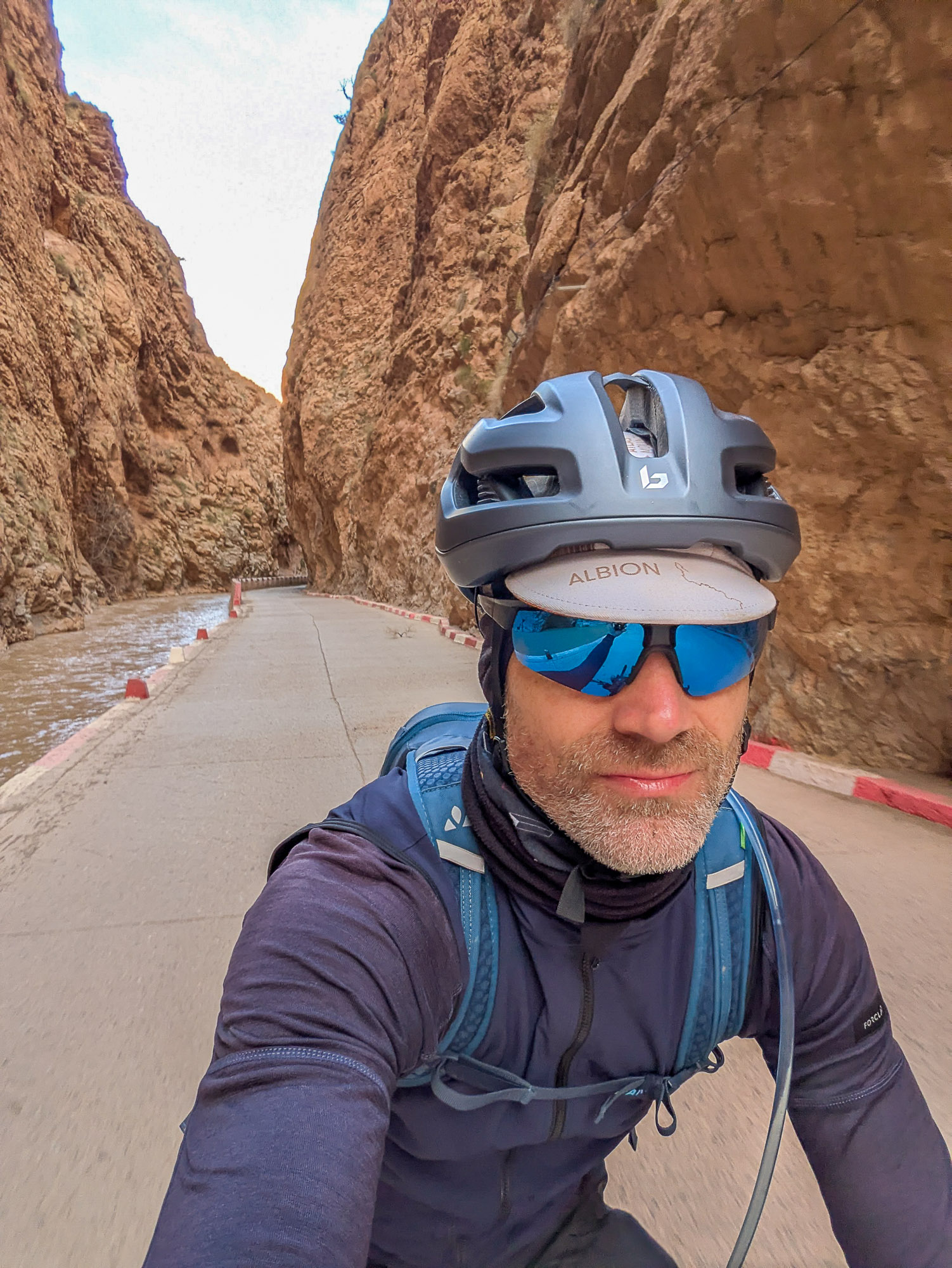
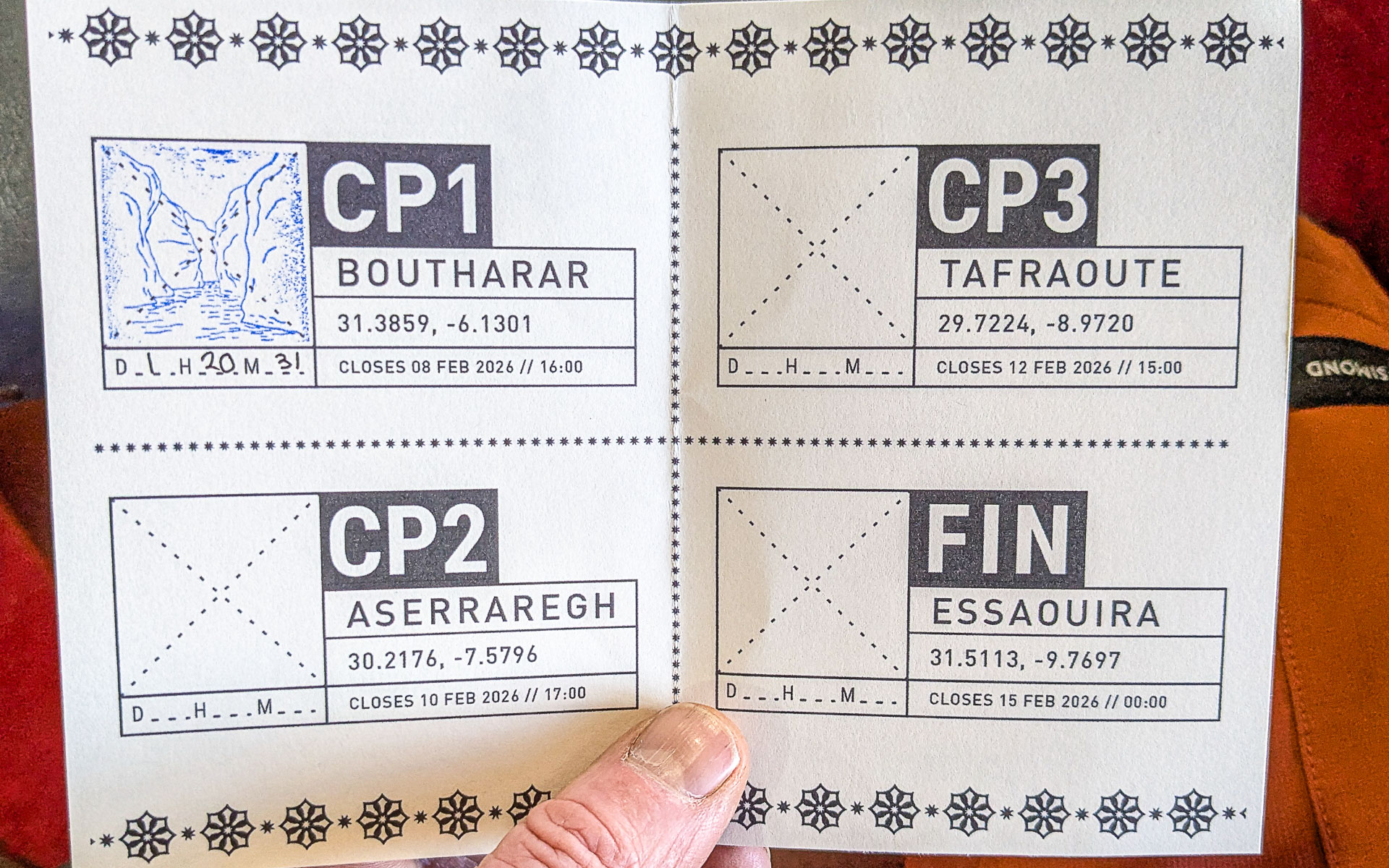
We reach CP1 in Boutharar, at kilometre 360, at 1:30pm. I’m exhausted. I’m reeling from these weather conditions. In the large hall, we help ourselves to delicious Moroccan dishes, tagines, cold drinks, pastries, and all-you-can-drink tea. It’s a welcome break, but I’m in bad shape. Physically battered, mentally drained. I’m not feeling very confident. The start was more than difficult.
And we’ve only just rejoined the original route and the trails of the real Atlas Mountain Race. The real race has only just begun. There are still 1,080 kilometres of trails to cover.
From CP1 to CP2: The Battle Against the Red Snail
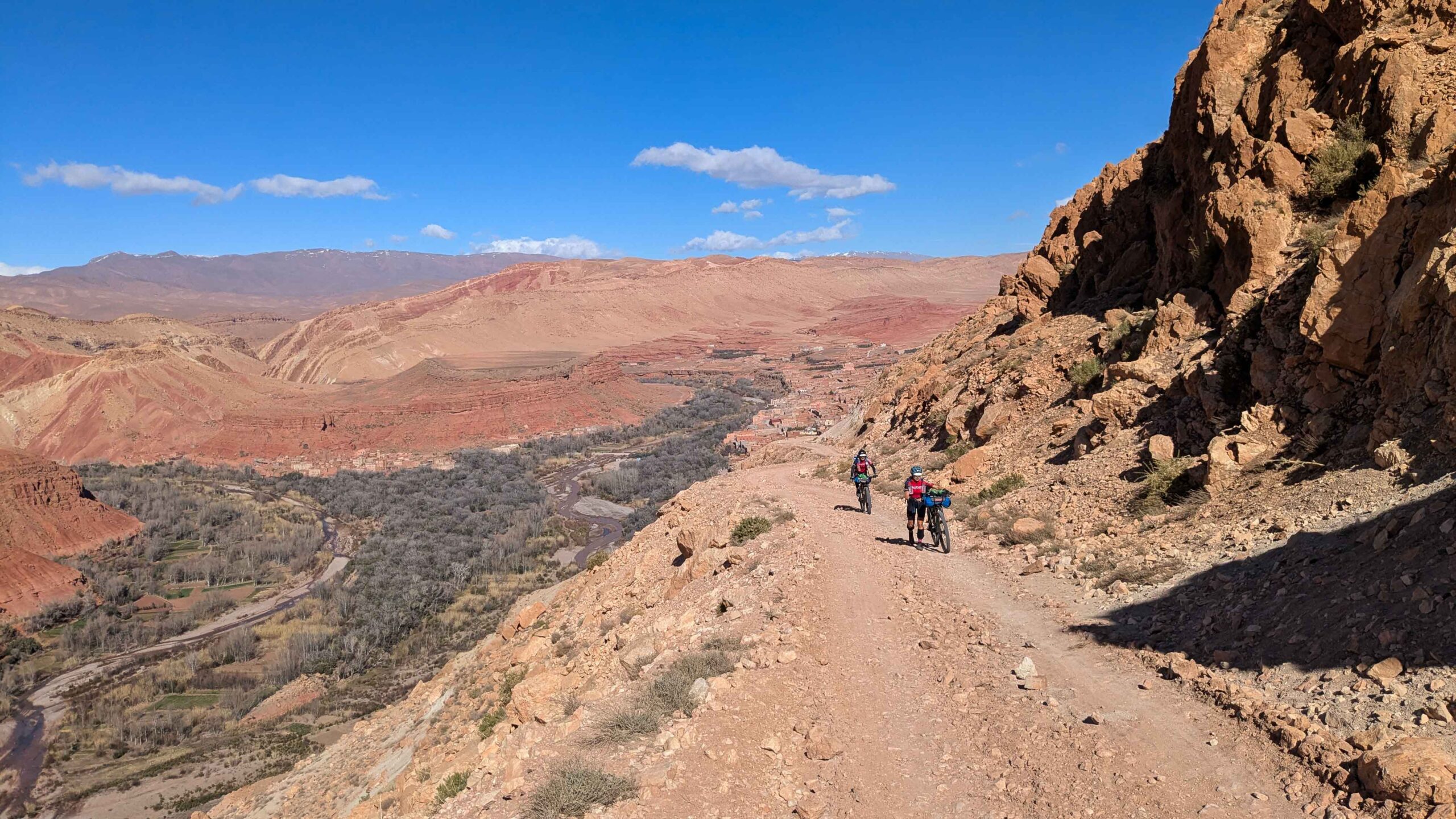
After struggling to reach CP1, I have to get straight back in the saddle to try to trick my body and mind, pretend that everything is fine, and hope to make up some lost time. I try to take a break 25 kilometres further on at a hotel in the Dades Valley, in the large town of Kalaat M’Gouna, at kilometre 385. But I can’t sleep. My heart is beating too hard. Not fast, but powerfully. After two hours of trying with no results, I decide to push through the night on the 100-kilometre stretch without any resupply between the Dades Valley and Afra, across the Saghro Mountains. I try to sleep again while camping in the desert, with no more success. During the long hike-a-bike section (where you walk your bike along mountain trails), I find myself in an informal group with a few other participants, including my friends Sebastian and Denise from Innsbruck, whom I met at the Unknown Race in Lyon two years ago. We don’t talk much; we have neither the time nor the energy.
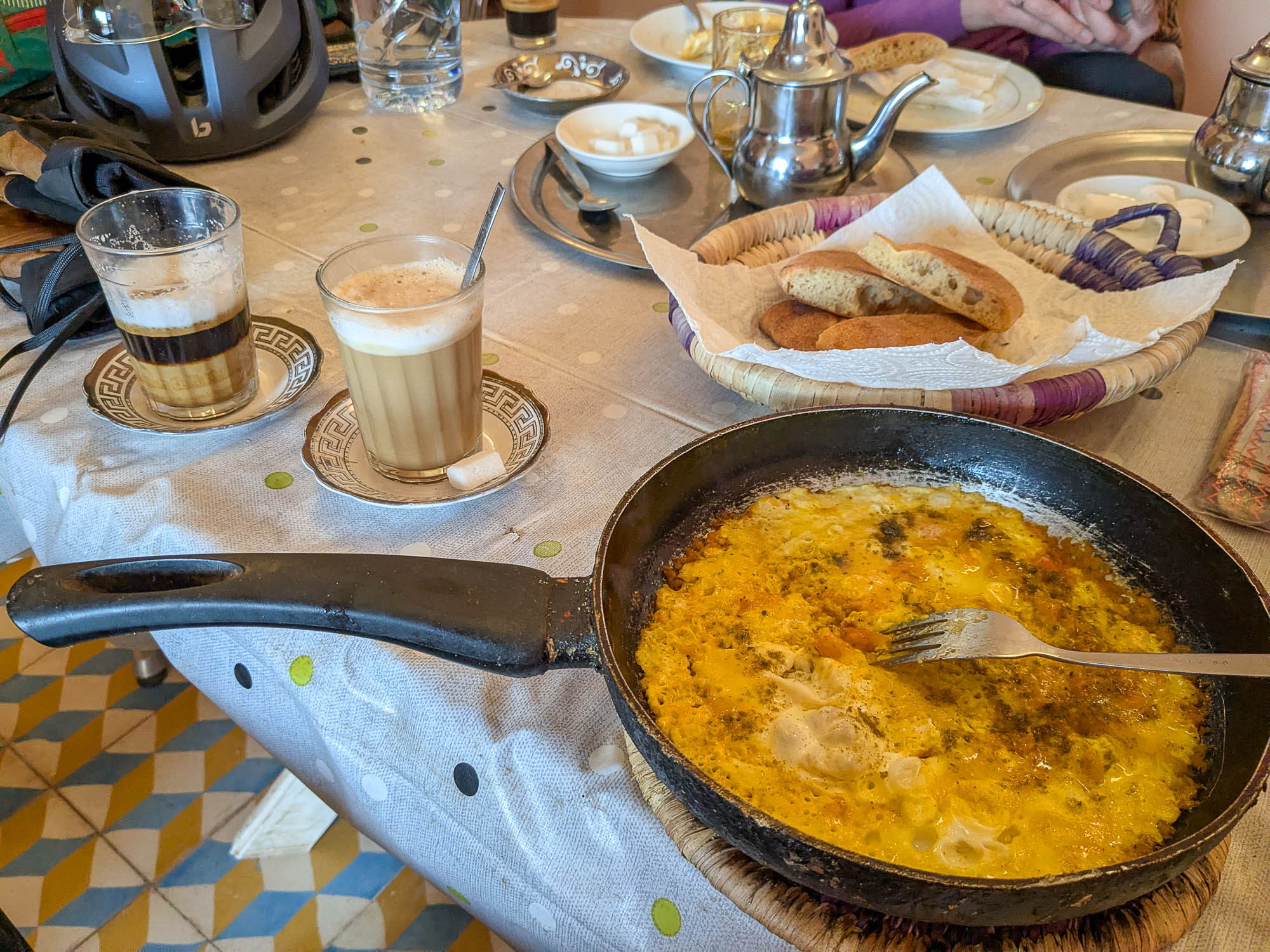
I reach the high plateau at sunrise—a stunning arid plain dotted with tufts of dry grass—then the village of Afra, at kilometre 488, around 10am. Moroccan schoolchildren gather around us; we chat briefly while I eat my first Berber omelette of the day.

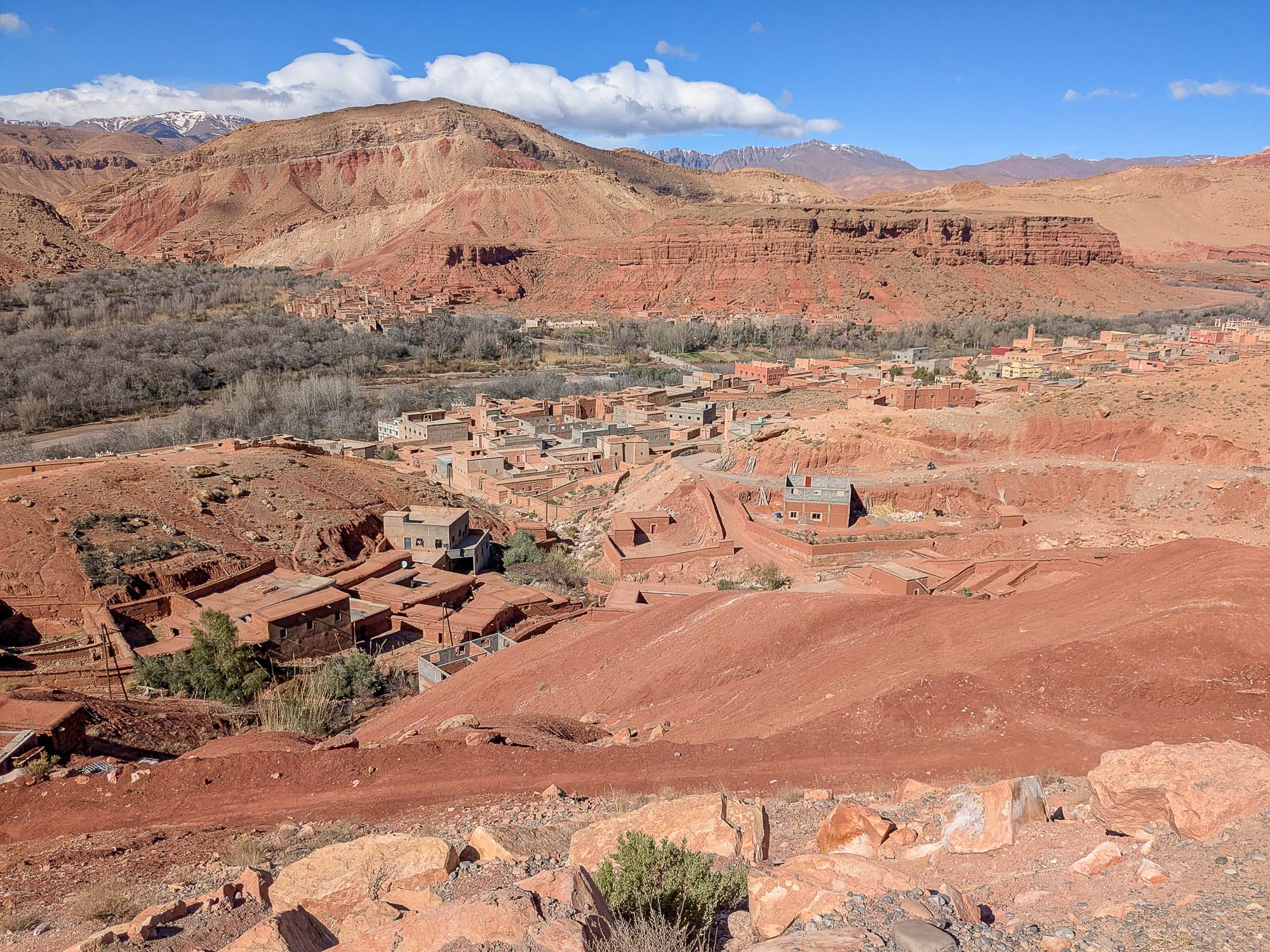
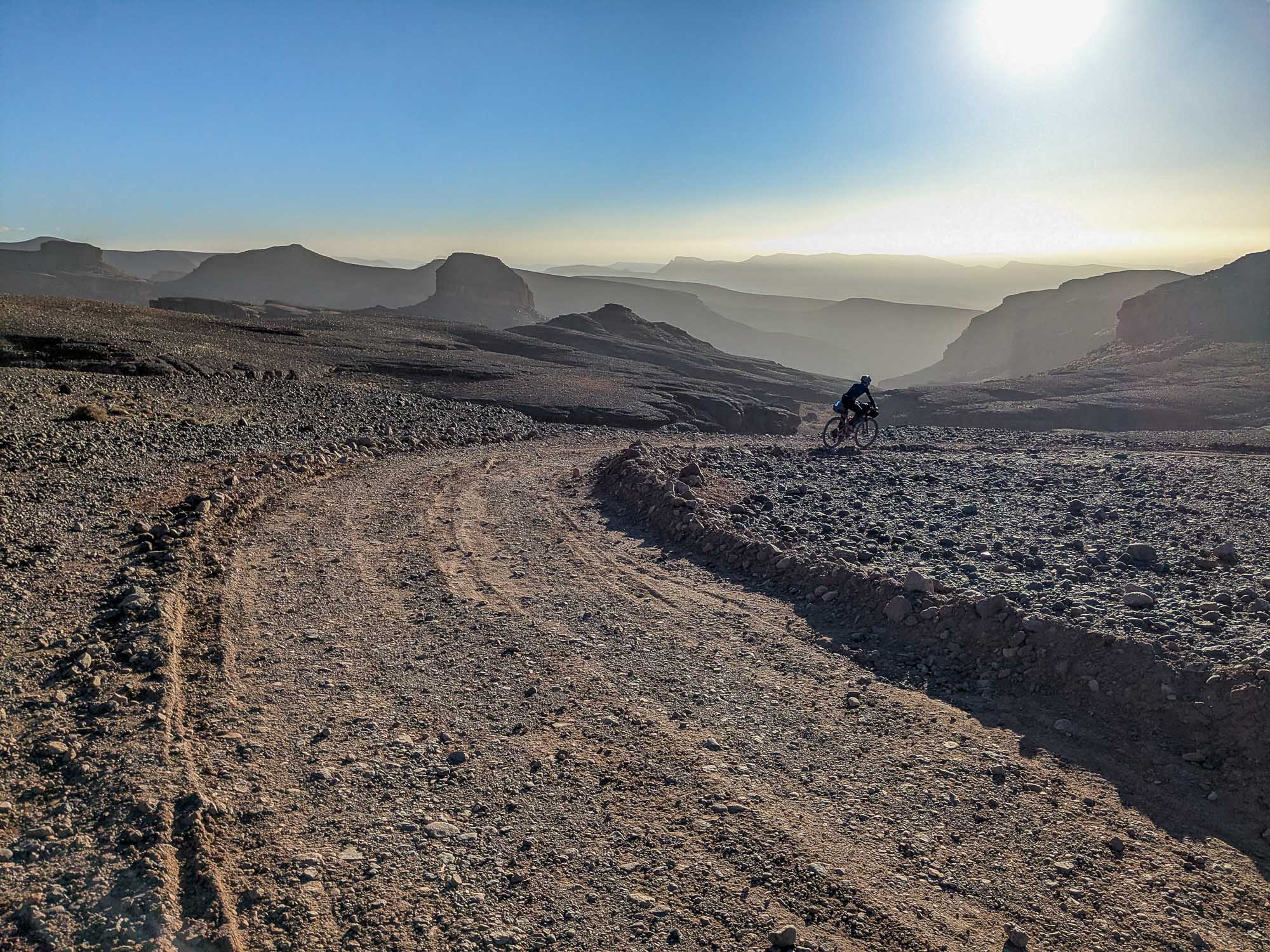

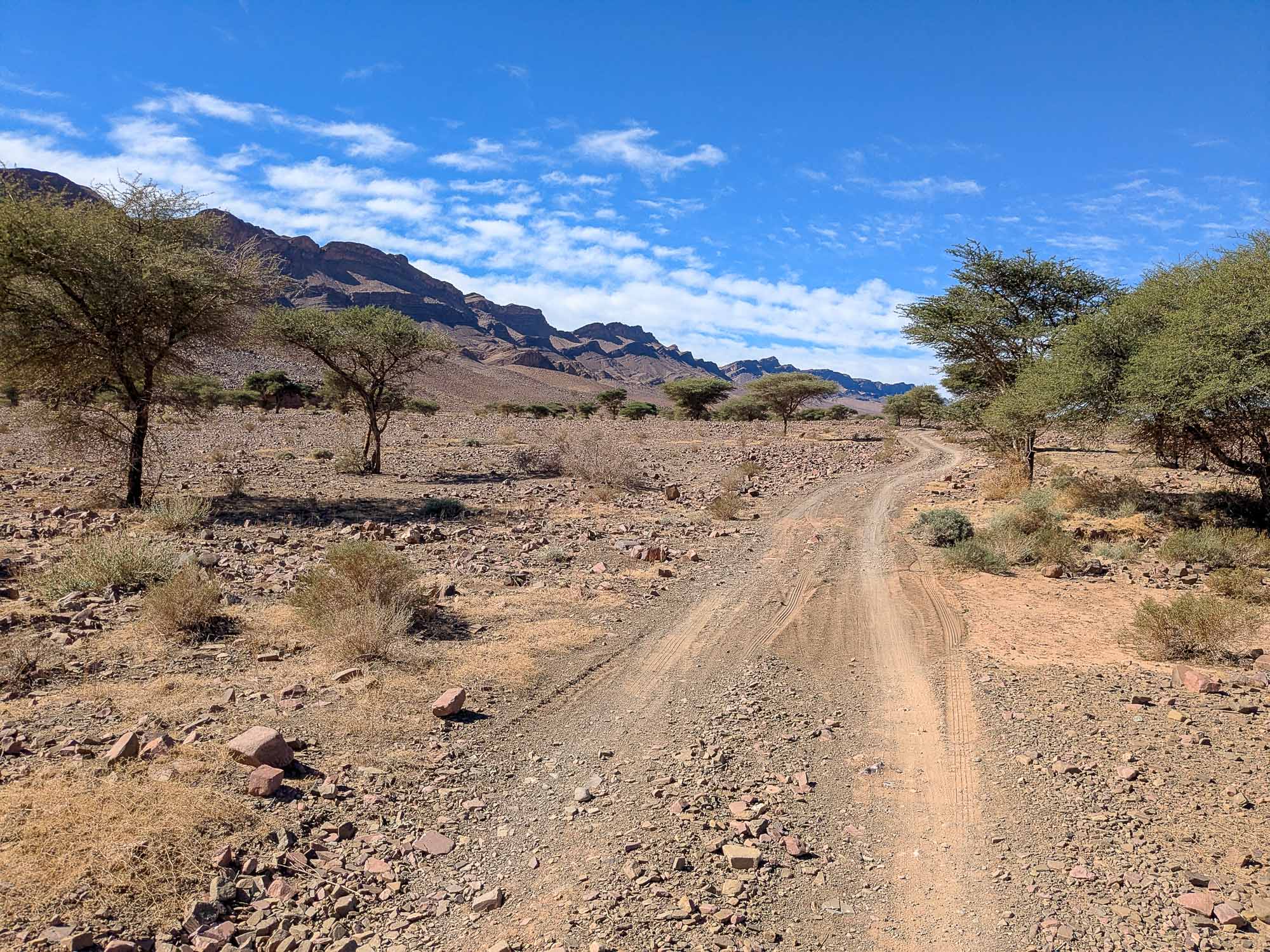
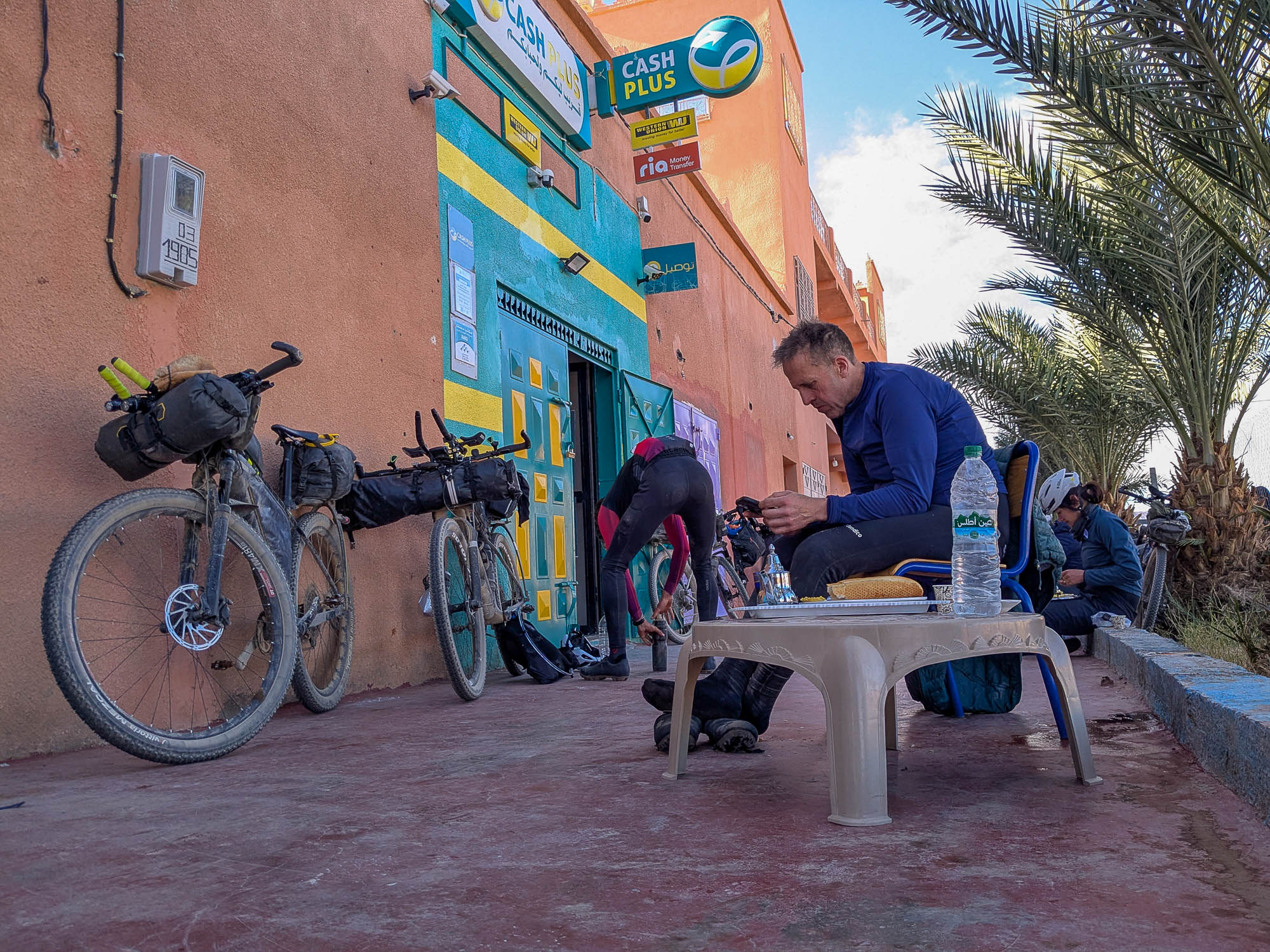
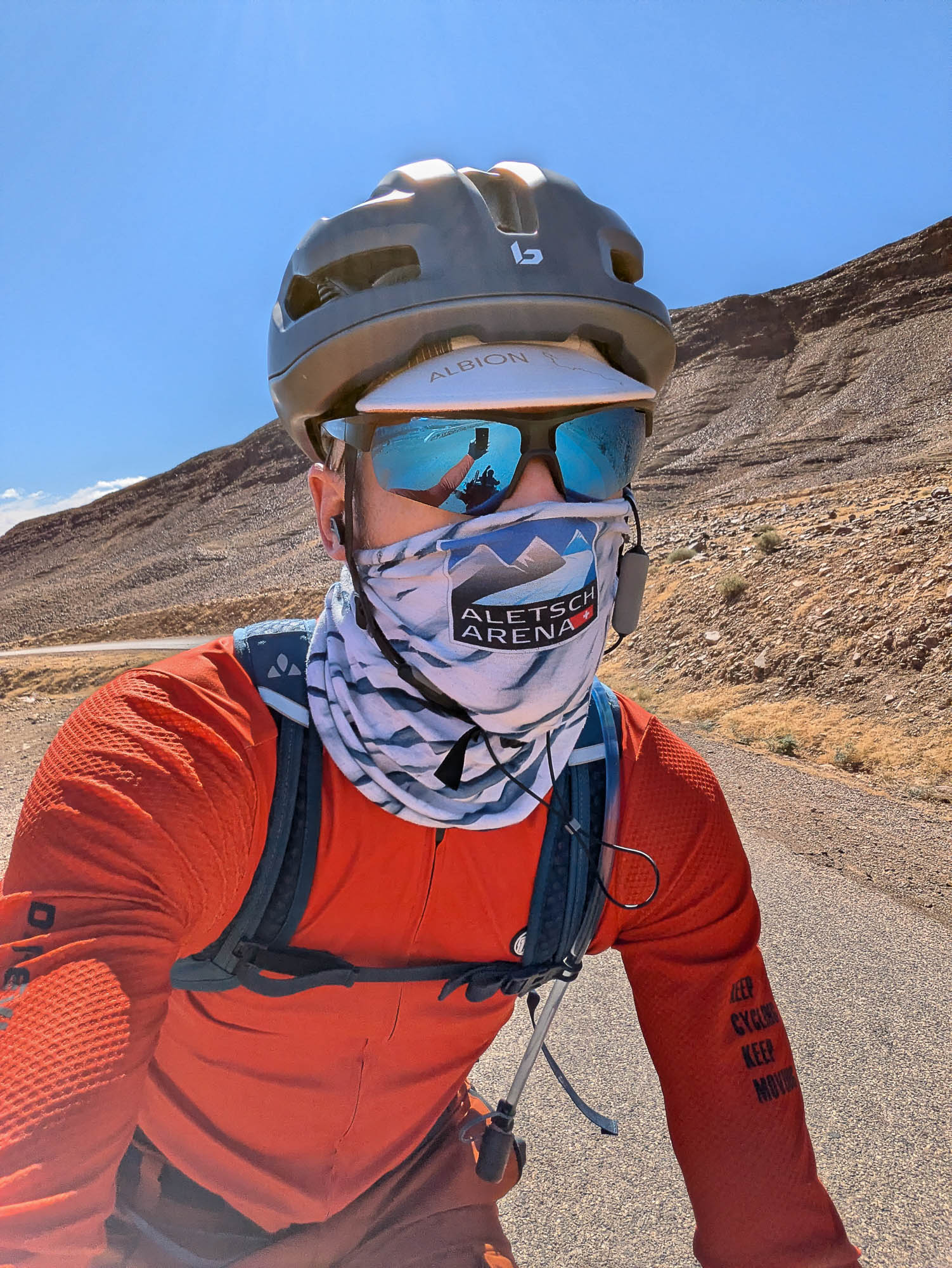
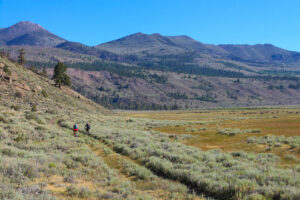
Once I’ve left the High Atlas and Saghro mountain ranges behind me, I enter the Anti-Atlas range, which is much sunnier, drier, and more remote. I’m fairly familiar with the 500 kilometres ahead, having covered them during the inaugural Atlas Mountain Race in 2020.
The hours begin to blend into a shapeless mass of time. After Afra, I ride on a rough track, follow a river along a trail hugging a cliff, pass through a ghost town, and begin a 27-kilometre climb under a scorching sun. I enter the village of Ait Saoun, kilometre 547, around 5pm. Once again, after a quick dinner, I can’t sleep.
I’m stressed out about the Red Snail.
On the map tracking participants’ GPS waypoints, the Red Snail represents the average speed needed to validate the checkpoints and reach Essaouira before the cutoff, the final time limit. The Snail never sleeps, never takes a break, and moves at a constant speed of 7.46 km/h. It doesn’t seem like much, and it isn’t, but it’s faster than my disastrous start to the race. And as soon as I take a break, the sneaky snail catches me up and overtakes. Basically, I’m running late. So it’s impossible to get any sleep. The general atmosphere in Ait Saoun is actually pretty discouraging. Everyone is behind schedule with various problems—pain, fatigue, damaged gear. I need to get out of here as soon as possible. I text my partner, who listens, reassures me, and advises me to keep moving forward—I can’t sleep anyway. And above all, I need to stop visualizing all the kilometres left to go. It’s too much for one brain to handle.
So I pedal through the night for hours, listening to a France Inter podcast on underwater and space exploration, before unrolling my bivvy and lying down around midnight in the middle of the desert, in what I thought would be my last camp of the adventure. At this point, I’ve decided to stop racing and continue in bikepacking mode to CP3 in Tafraoute. It’s too hard. And I’m not enjoying it enough to make up for the difficulty. I feel like this time, the bar is set too high for me. I’ve resigned myself to giving up. I don’t really mean it. I’m just tired. Once the headlamp’s light goes out, the starry sky comes alive, and it’s absolutely incredible. I have time to count two shooting stars before drifting off to sleep.
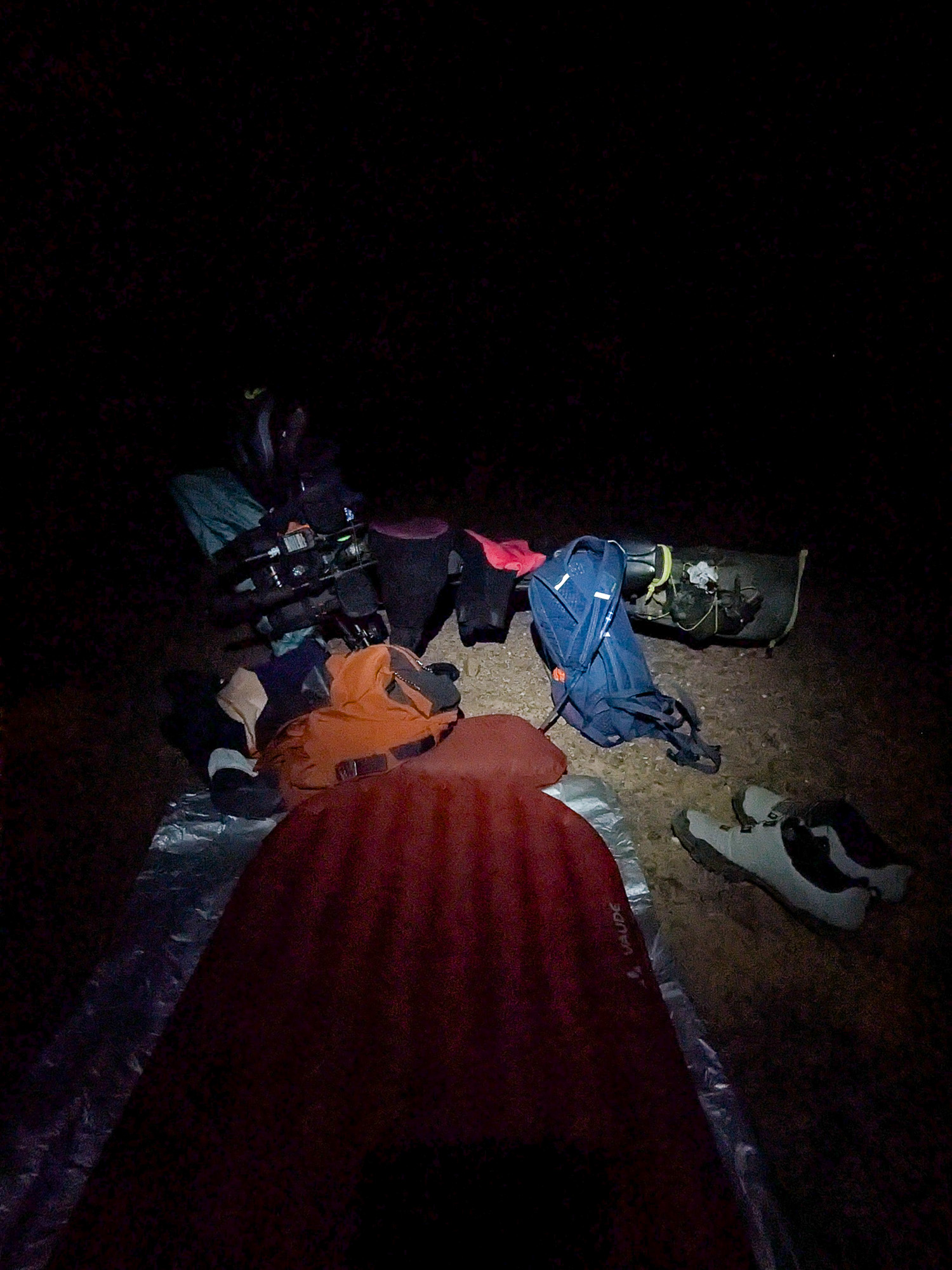
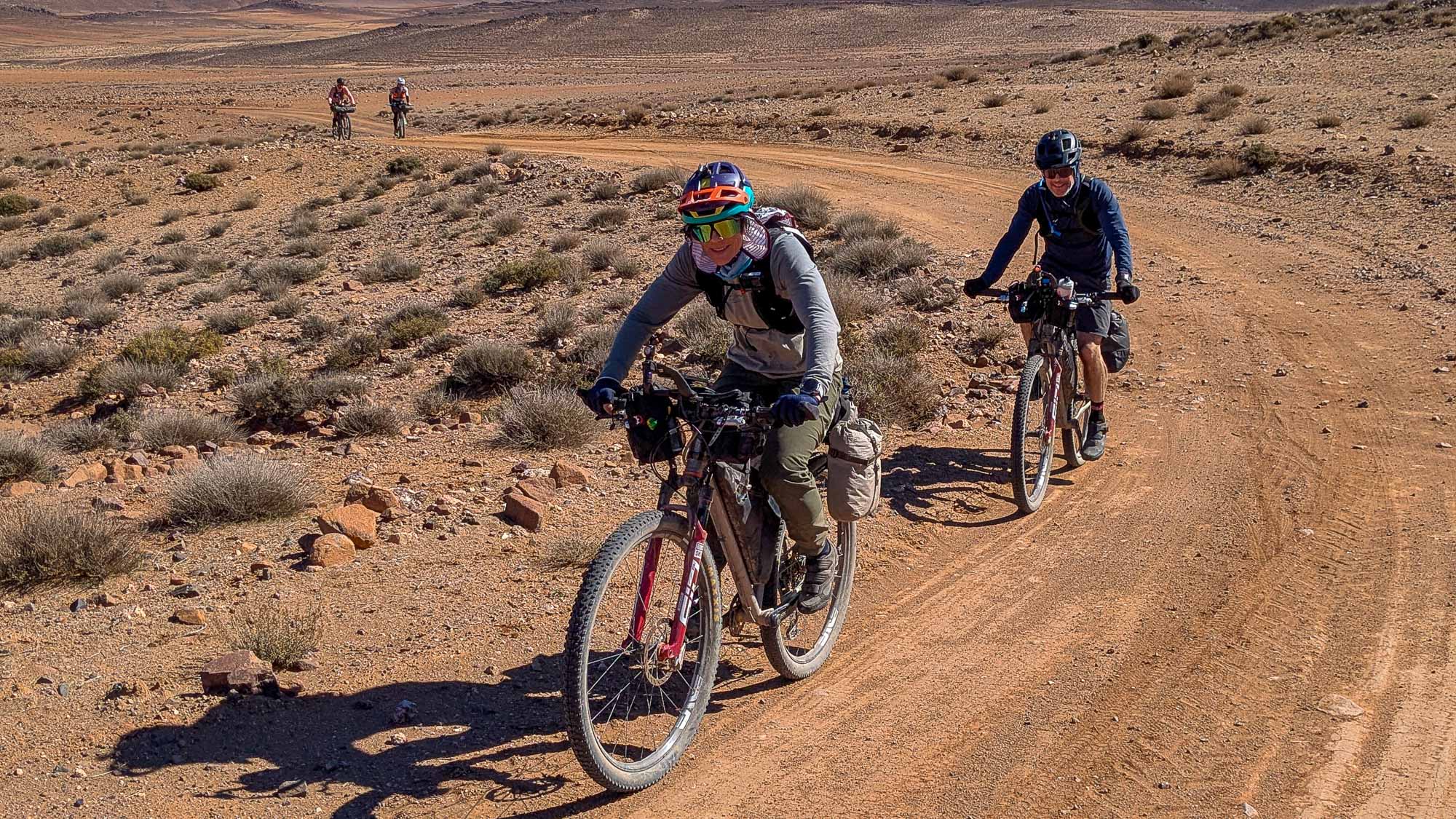
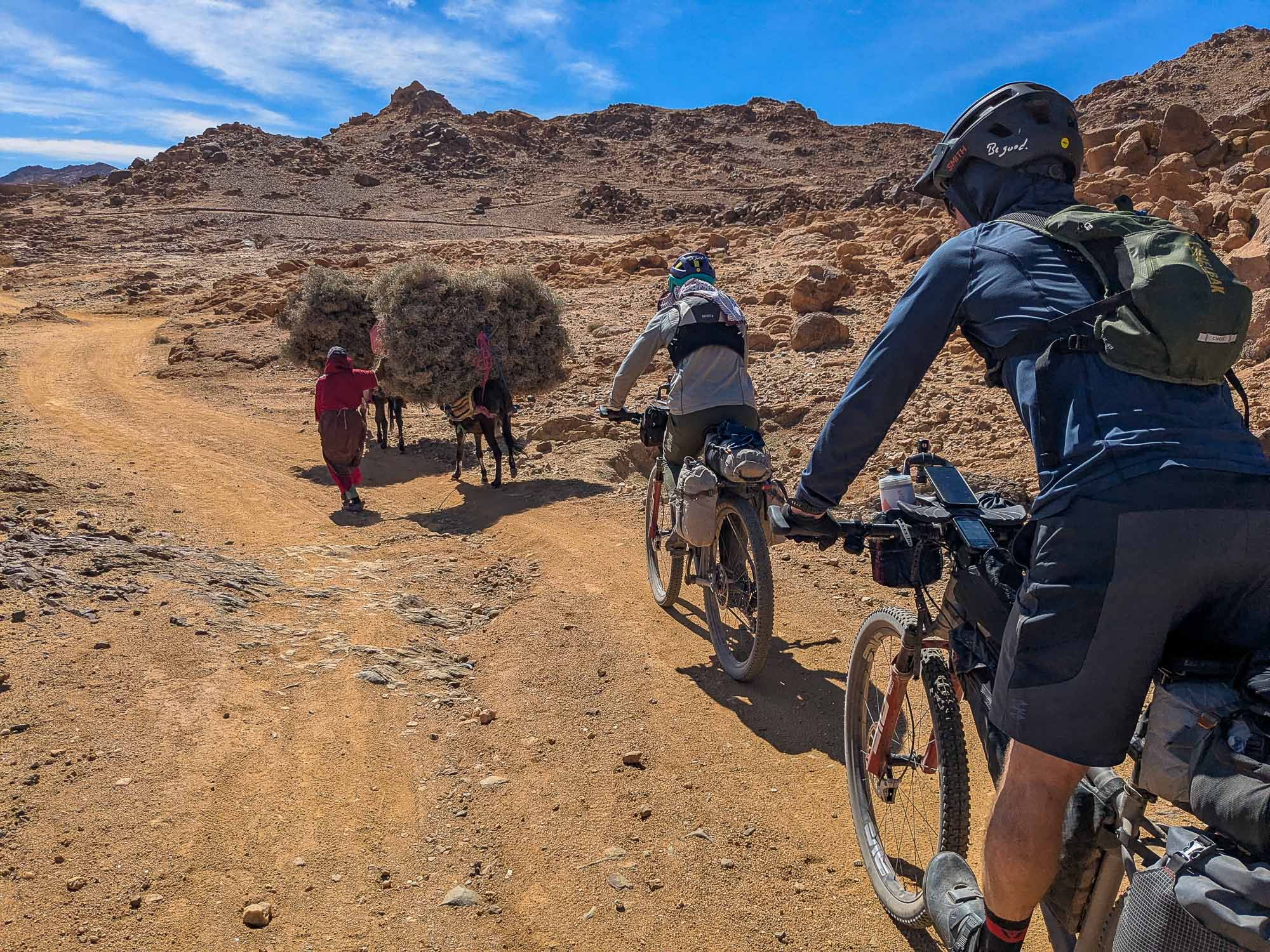
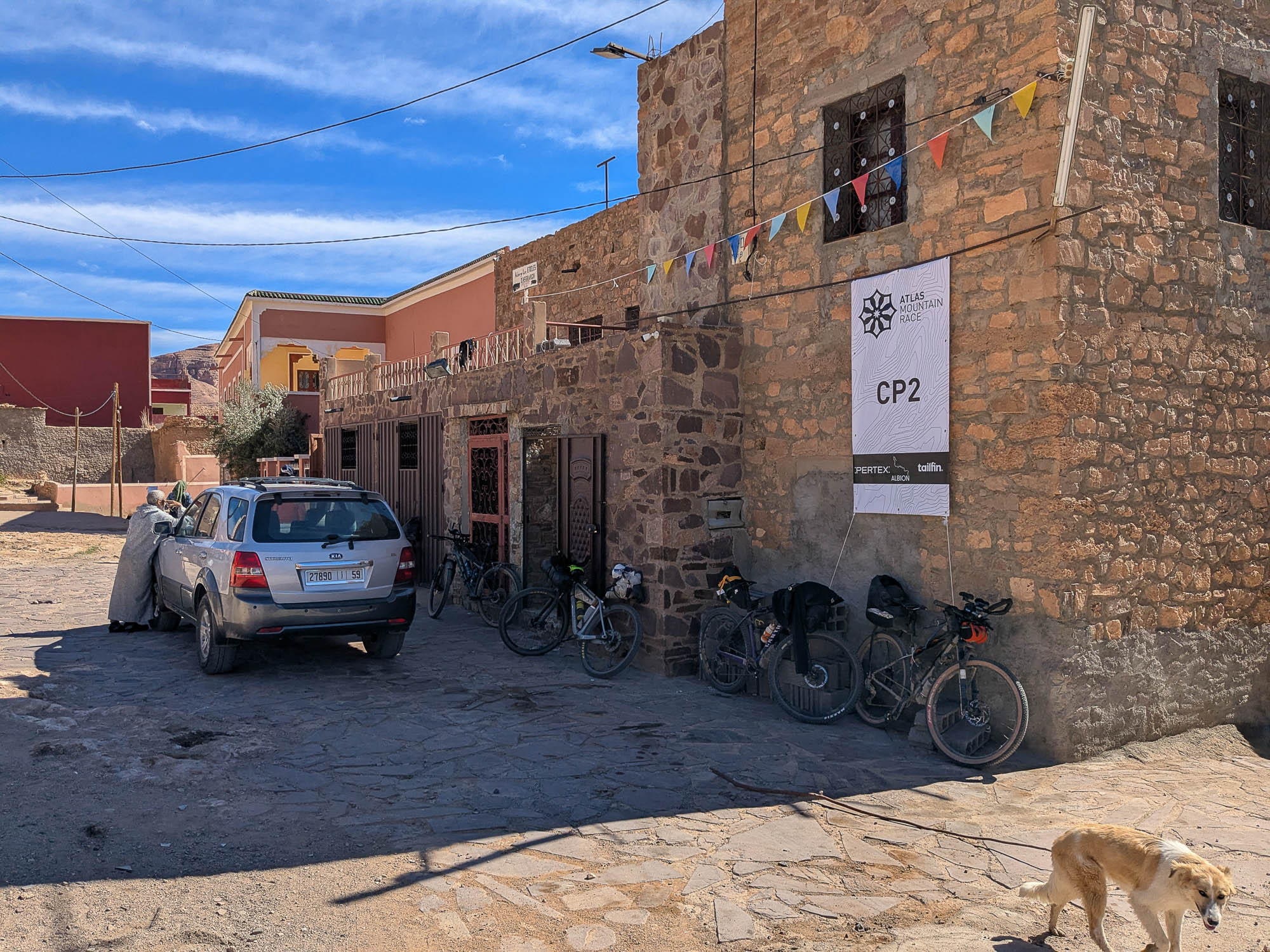
After two hours of sleep (finally!) under the stars, I set off again on fairly smooth trails to reach Taznakht, kilometre 624, around 6am, where I crash for three hours in a hotel bed vacated by another participant just minutes earlier. After three glasses of freshly squeezed orange juice, three lattes, and eight slices of toast, butter and honey, I set off again under the desert sun towards CP2, 76 kilometres away. The landscape is apocalyptic, scorched as if seared by a blowtorch. I’ve got tons of energy this morning; I pass several participants and feel like I’m flying. I reach CP2, kilometre 700, at 2pm, in the cheerful company of Rebecca and Greg from Idaho.


CP2 is magical. The floor and walls are bright, covered in ceramic tiles. The food is good and varied: chicken couscous, soft drinks, fruit, Moroccan pastries, and hot tea. And above all, the atmosphere has changed since Ait Saoun. I rode well, and I’ve left the stifling atmosphere of the tail end pack behind me. The Red Snail can go take a hike. Here, everyone is looking ahead. We’re talking about CP3 in Tafraoute, 300 km away.
Suddenly, the race picks up again.
Last night, I broke the number one unwritten rule of bikepacking: never give up at night. The next day always brings its share of surprises.
I feel like I’m opening my eyes for the first time since Beni Mellal, like I’m coming up for air. Reaching Essaouira is now within my sights. I’m both happy to be back on track, but I realise I’ve only covered half the route. It’s a sort of simultaneous hot and cold feeling. On the AMR, no kilometre is a free ride; every stretch is conquered through physical, and above all, mental strength. And here I am, I’m doing fine. I’m not sore anywhere except my butt, so I ride on. Vamos!
From CP2 to CP3: The 300-kilometre Resurrection
In the evening, after tumbling down the palm-lined Aguinane Gorge and crossing a small mountain range on a rough trail, I reach Ibn Yacoub, kilometre 780, at nightfall, accompanied by Bastien, a guy from Lyon who I chat with over a long 20 kilometre stretch of gently sloping asphalt. A local opens the doors to his small café and the building’s first floor, where a large room offers us a bit of rest. There’s even a shower. A hot one! Absolute luxury.
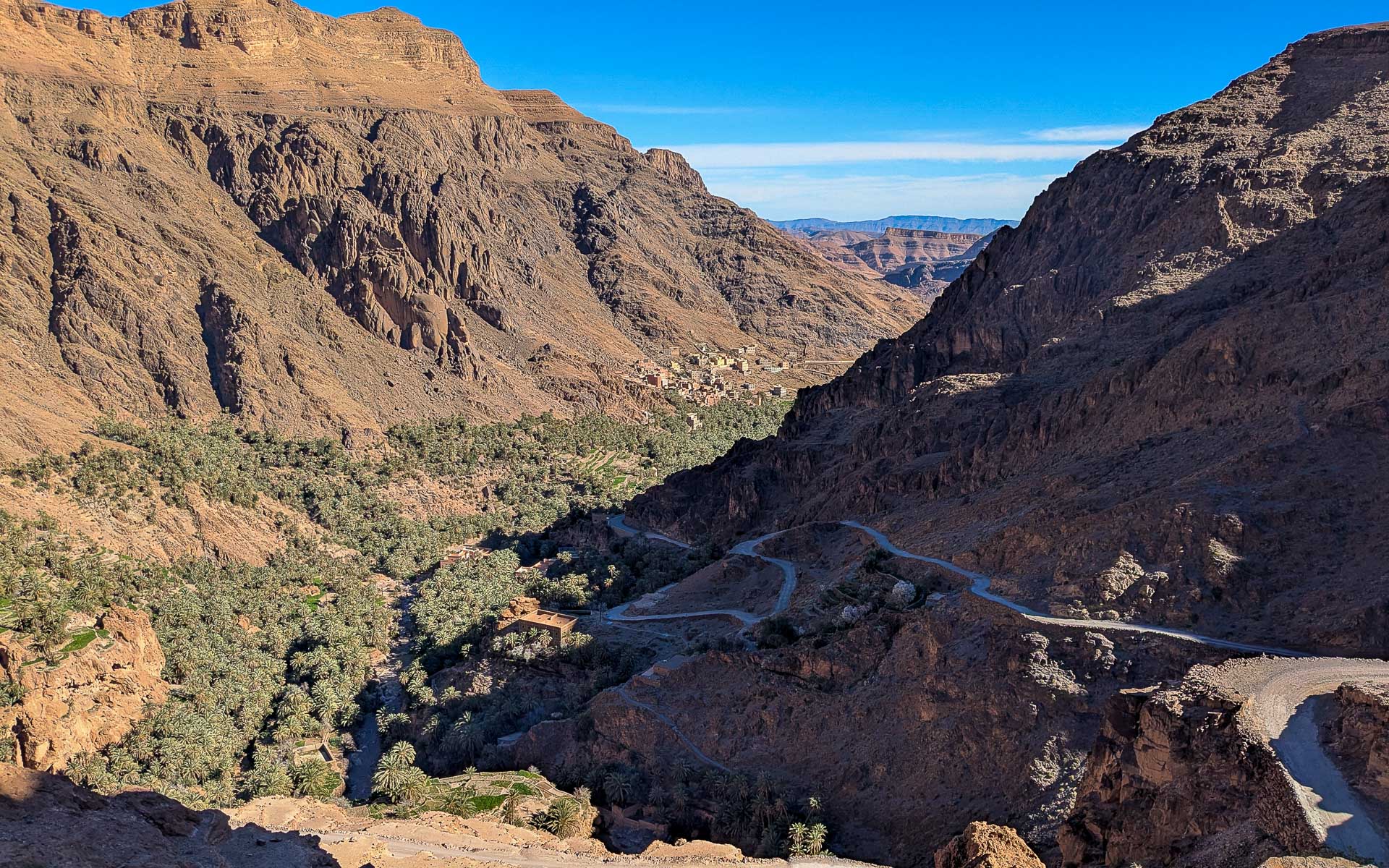
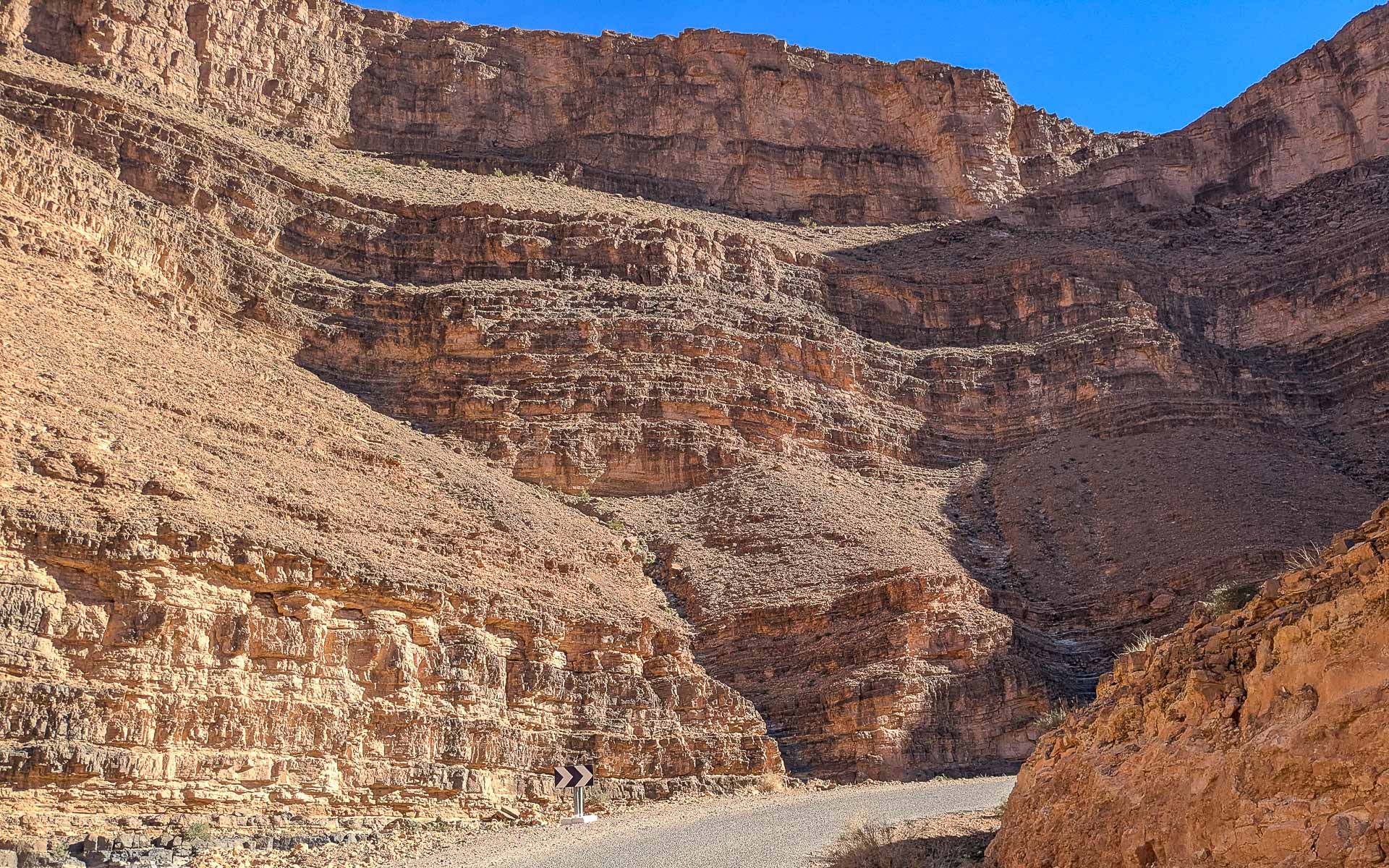
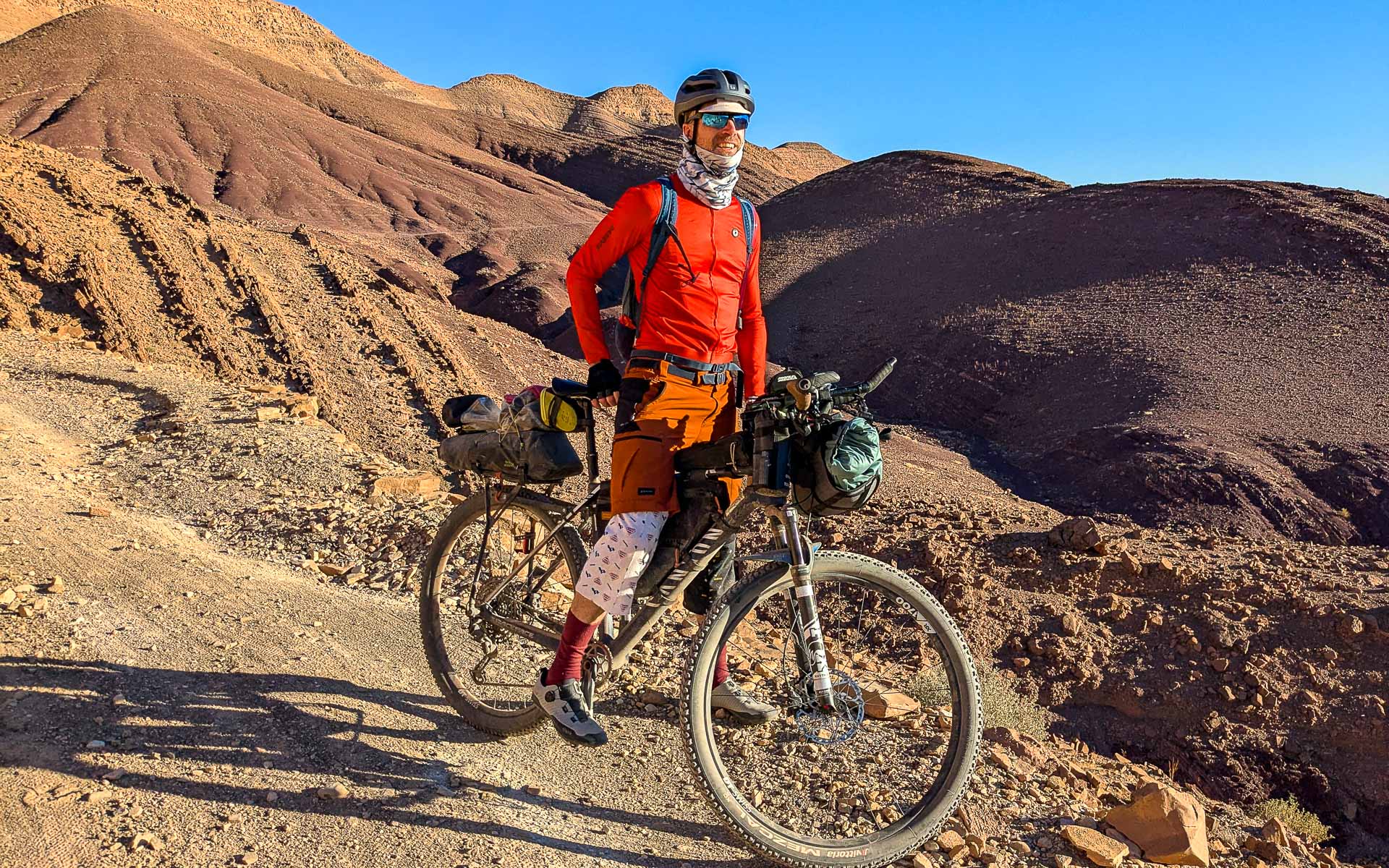
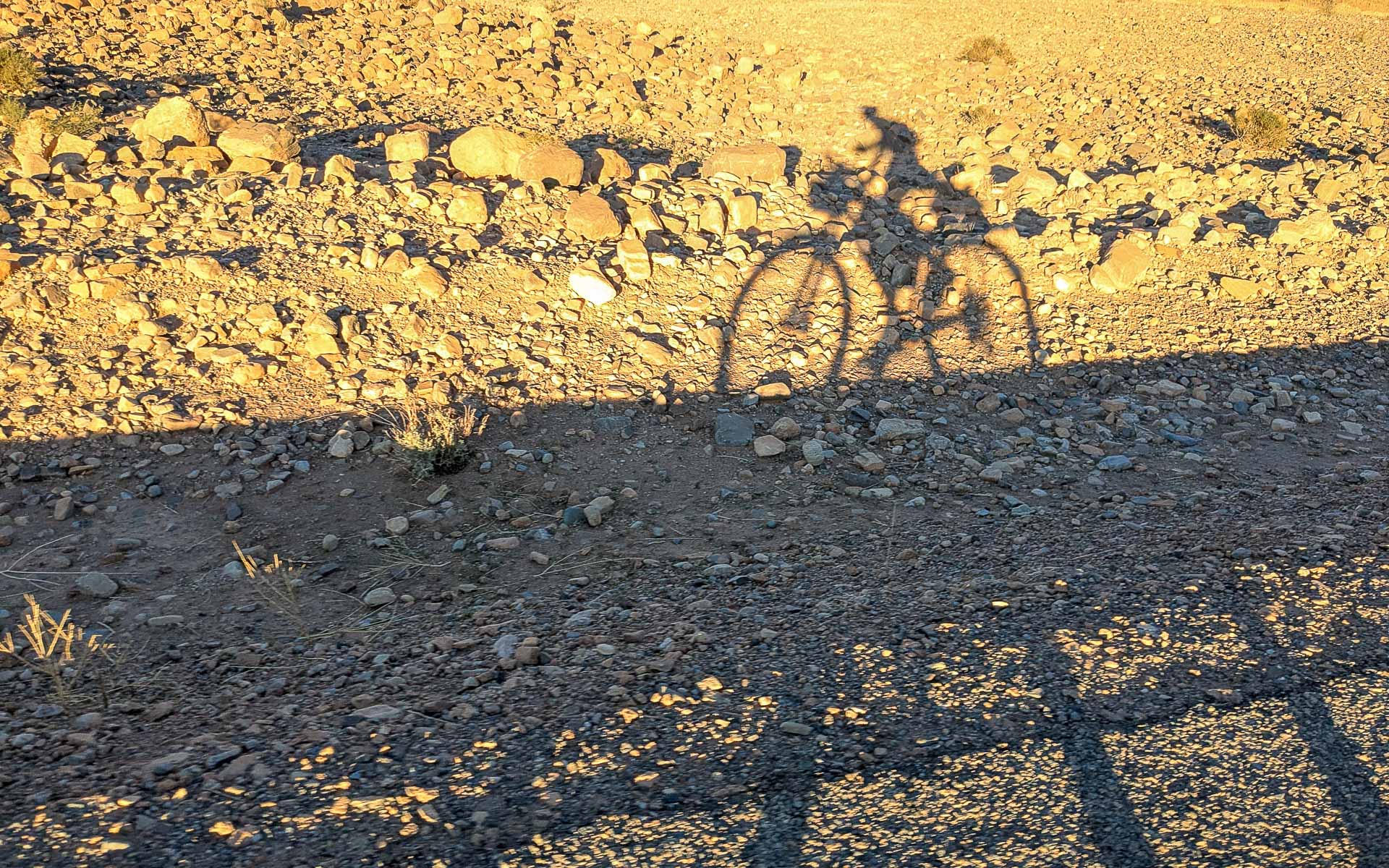
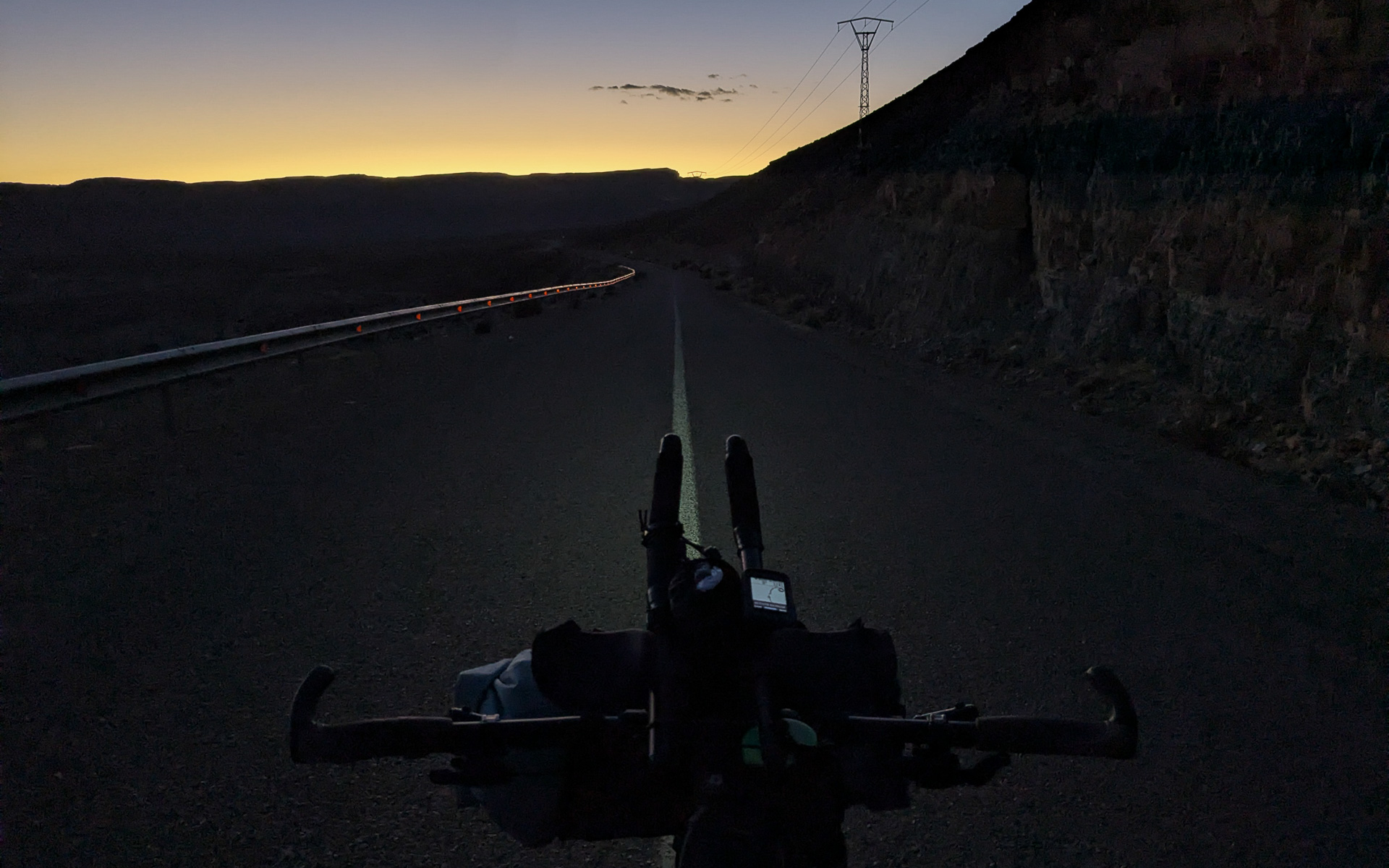
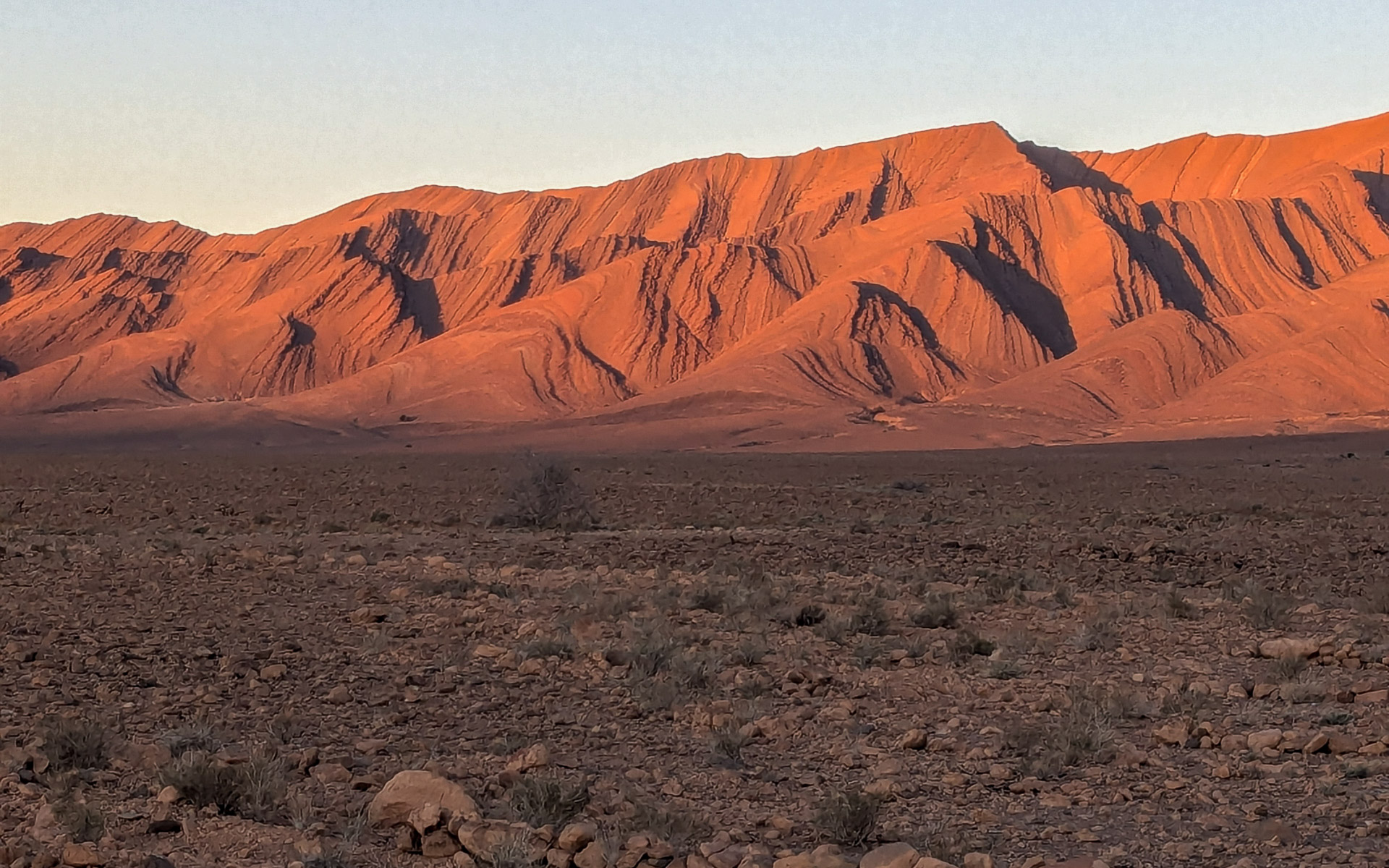
After sleeping four hours, I’m back in the saddle for one of the most intense and beautiful days I’ve ever spent on a bike. With Bastien, we cross an endless riverbed by the light of our headlights, cluttered with boulders the size of basketballs that make us slip and slide as we walk. In some places, recent floods have covered the trail with a thick layer of rocks. Most of the time, there isn’t even a trail. Fortunately, there’s no water in the river. We finally reach Tagmout, kilometre 822, just before sunrise. The village is nestled at the foot of a mountain range crossed by the iconic colonial road: 55 kilometres of track lost in the middle of the desert, built a century ago in an arid and very remote environment and forgotten 20 years later. It traces a straight, sloping line through the undulating, orange-hued rock strata of the Anti-Atlas. A beautiful stretch, sometimes cluttered with large rocks, where I ride intermittently with Sébastien and Denise. On the long descent, I hit a rock. The rear tire splits open, leaving a 1cm gash. The tubeless sealant seeps out into the open air. I make a quick fix by installing an inner tube. It’s in moments like these that we realise just how isolated we are. Here, on foot, we’re far from everything. We’re in another world.

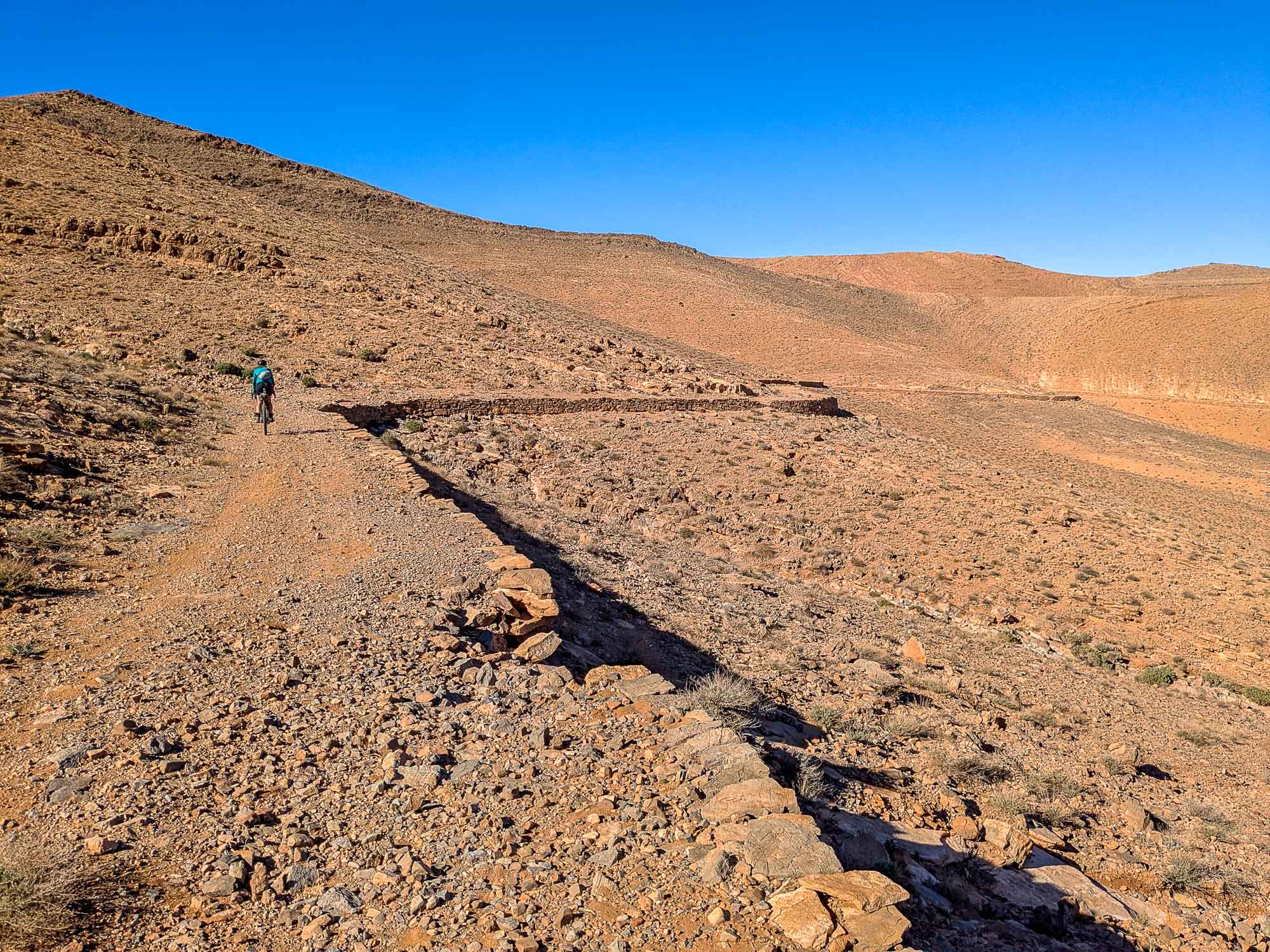
Fifteen minutes later it’s fixed. Half an hour later, I polish off a Berber omelette and two litres of water and Coke in Issafen, at kilometre 885. Sebastian and Denise quickly catch up with me. We chat for a bit. I’m in a chatty mood which is a good sign.
I quickly set off up a narrow, winding canyon lined with perched villages and palm groves until I reach a gravel track as wide as a motorway, situated at the top of a high, undulating desert plain with a 360° unobstructed view of the surrounding peaks, that look like huge waves. A superb, surreal route, on a fantastic trail, which I race down at supersonic speed, pushed by a powerful rush of adrenaline and a strong tailwind.


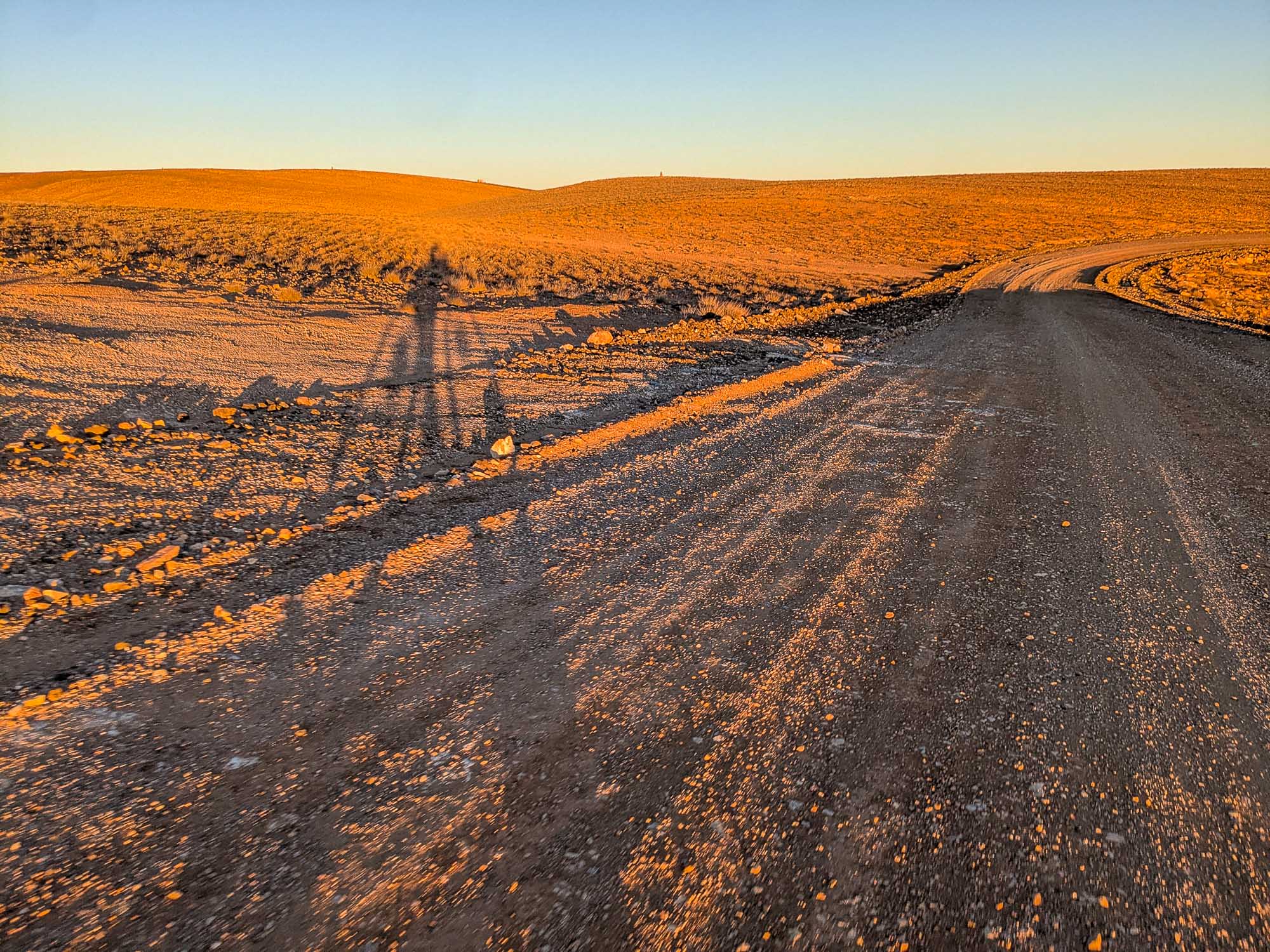
Sunset, music in my headphones—I’m in the groove; this is an absolutely amazing day. It’s beautiful, it’s vast, it’s remote, it’s epic—it’s everything I love. I head back down into the Aït Mansour Gorge and its linear palm grove as night falls, then it’s the final push to reach Tafraoute, CP3, kilometre 1003, in the dead of night, around 1:50am. A stamp on the race card, a mountain of spaghetti bolognese, avocado juice, a double bed—total bliss. The volunteers are giving it their all, boosting us on with their smiles and encouragement.
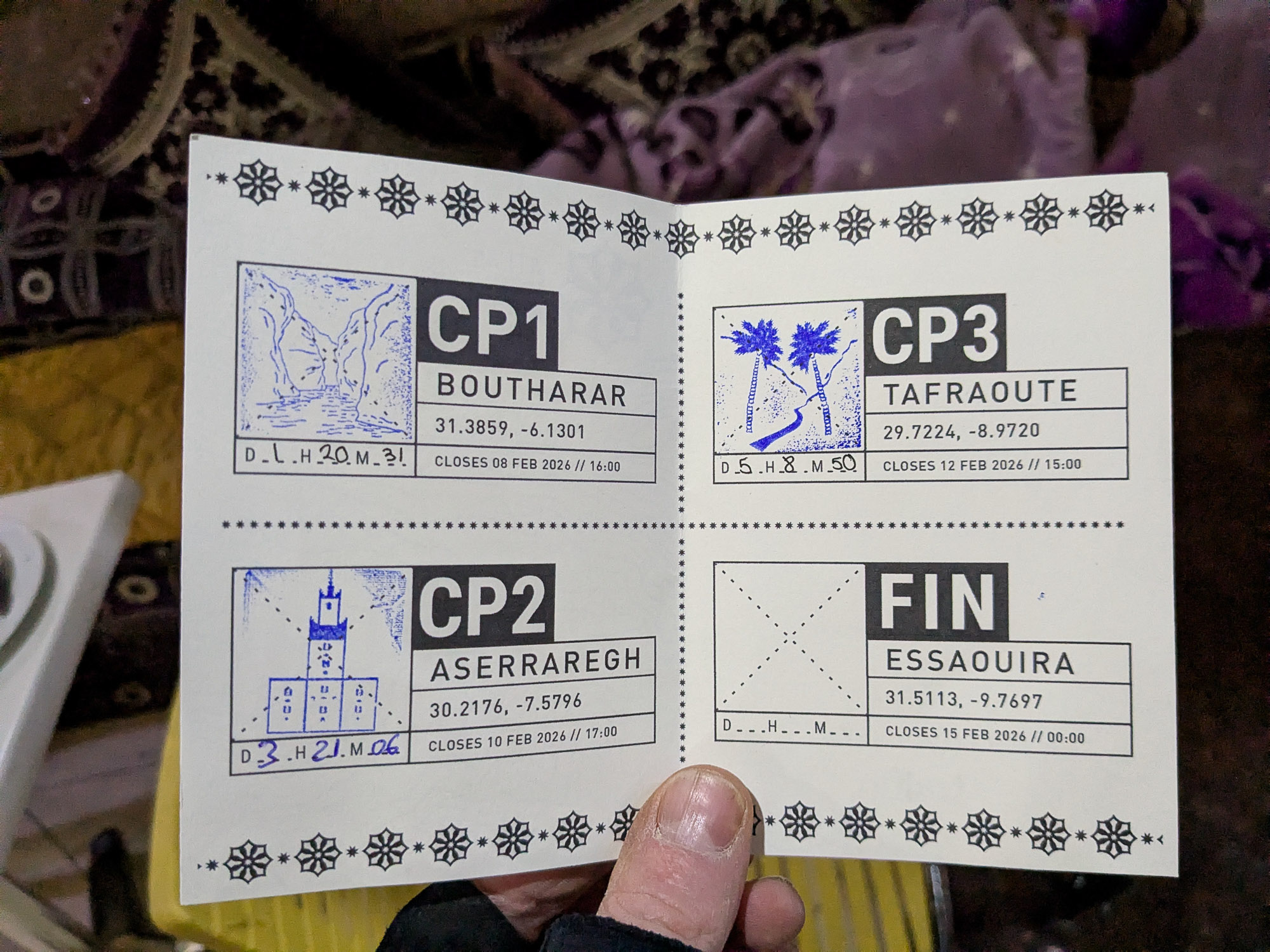
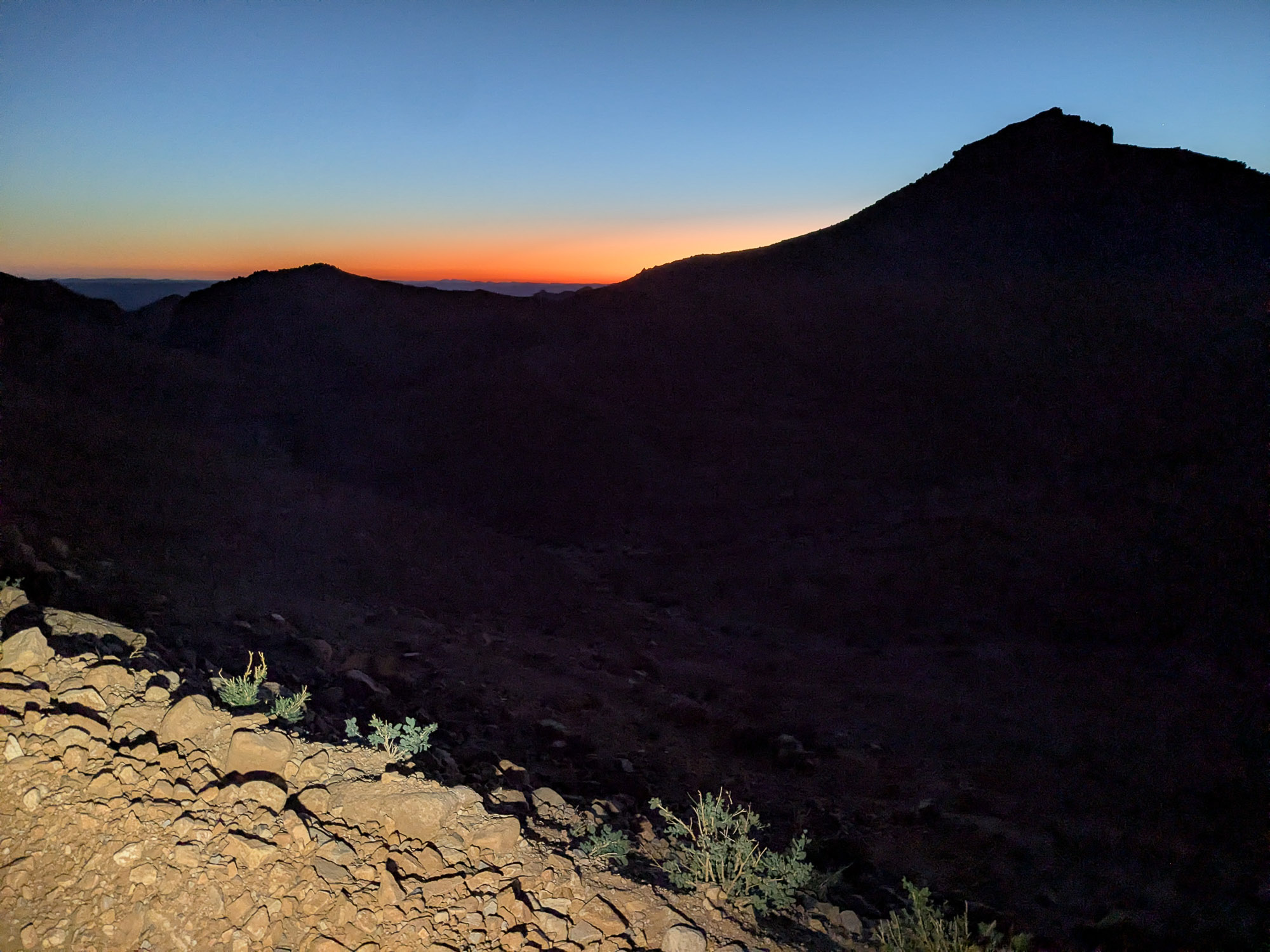
Messages of encouragement are pouring in on the WhatsApp group my partner created for the occasion. Friends, family. It feels like the Olympics. I’ll never find the right words to describe the energy this support gives me. It’s like riding with a tail wind.
I’m all beat up, but I’ve made good progress. There are still 440 kilometres to go before the finish line in Essaouira. I’m not quite sure how I made it this far. But I’m here. And I’m pretty happy about it. But right now, I’m going to sleep for four hours before setting off again.
From CP3 to the finish in Essaouira
At CP3, a third of the total route still lies ahead. Morale is high; the race’s first two gruelling days seem like a distant memory. Setting off from Tafraoute, I cross the Atlas Mountains once again, heading due north, mostly on paved roads and up double-digit gradients. The scenery has changed. The mountains are smaller, and the landscape is lush and green; clear water flows in the riverbeds, and we ride on loose dirt trails lined with thick grass. The Atlantic coast must be about 40 kilometres away as the crow flies. I pass through the high-altitude villages with Hannah, race coordinator of the Trans Continental Race (TCR), a 4,000-kilometre-plus bike race across Europe held every August. We ride on concrete tracks above a sea of clouds before plunging into the mist and cursing a long climb up a riverbed, which we cross on foot, pushing our bikes.
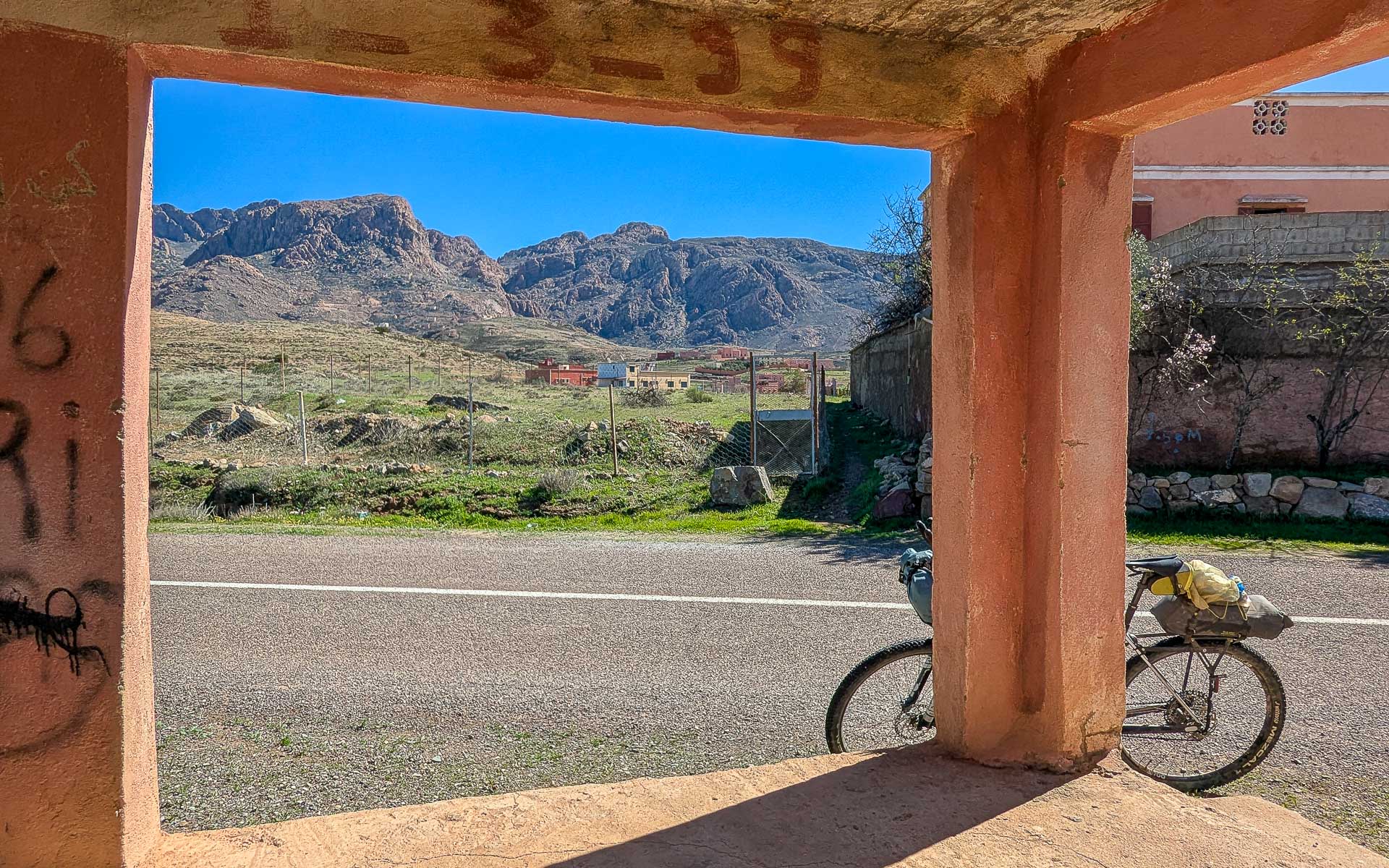
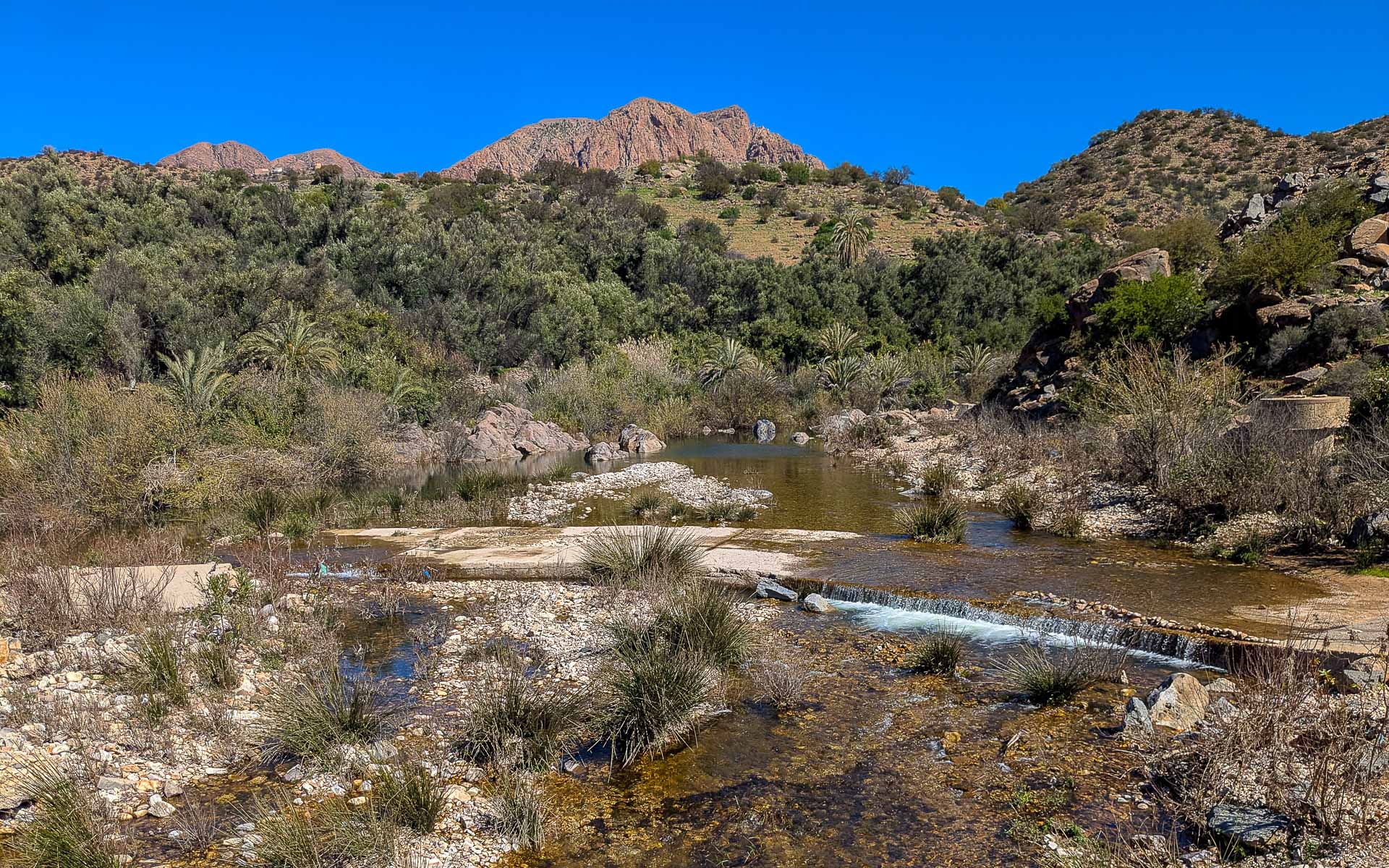
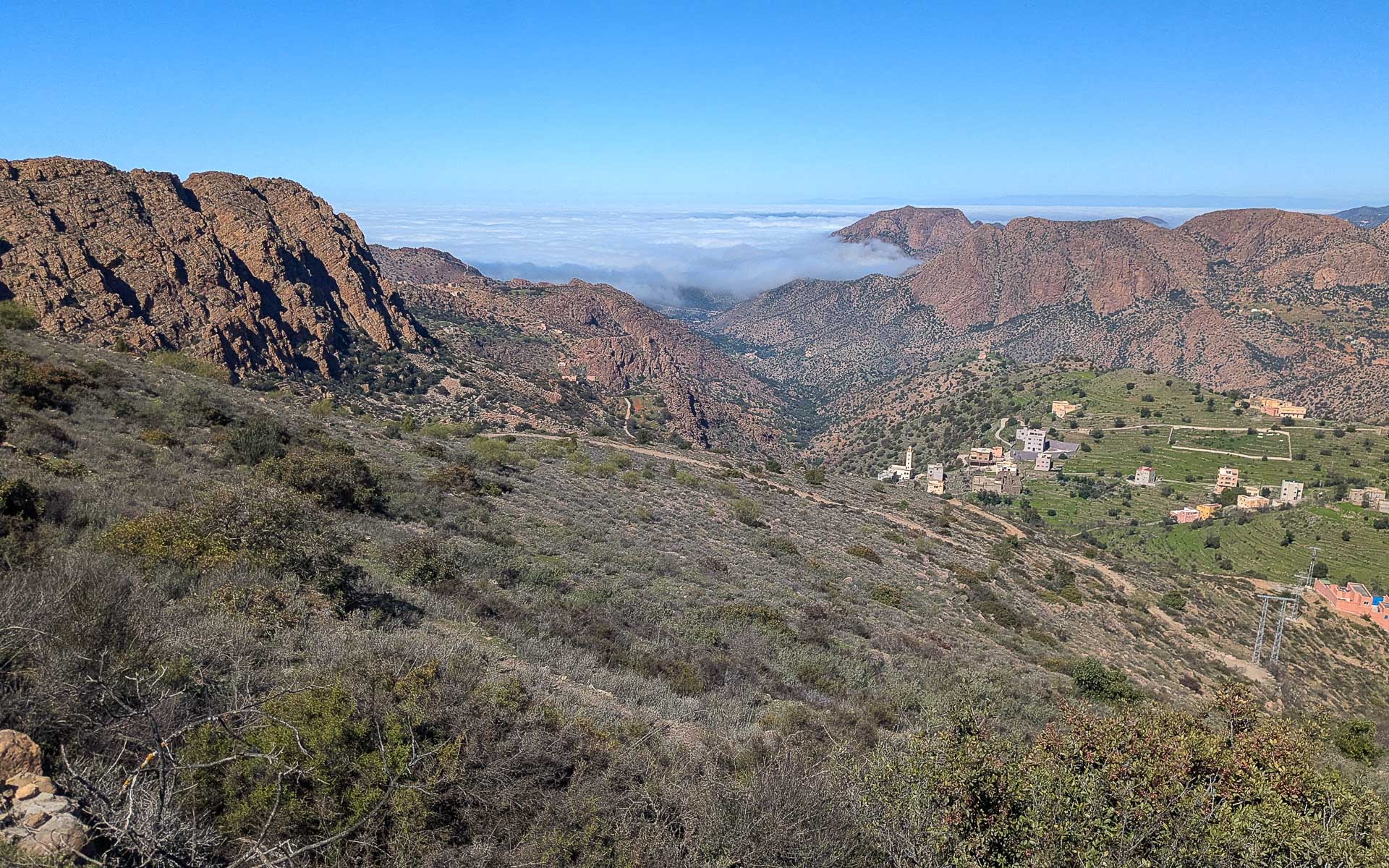
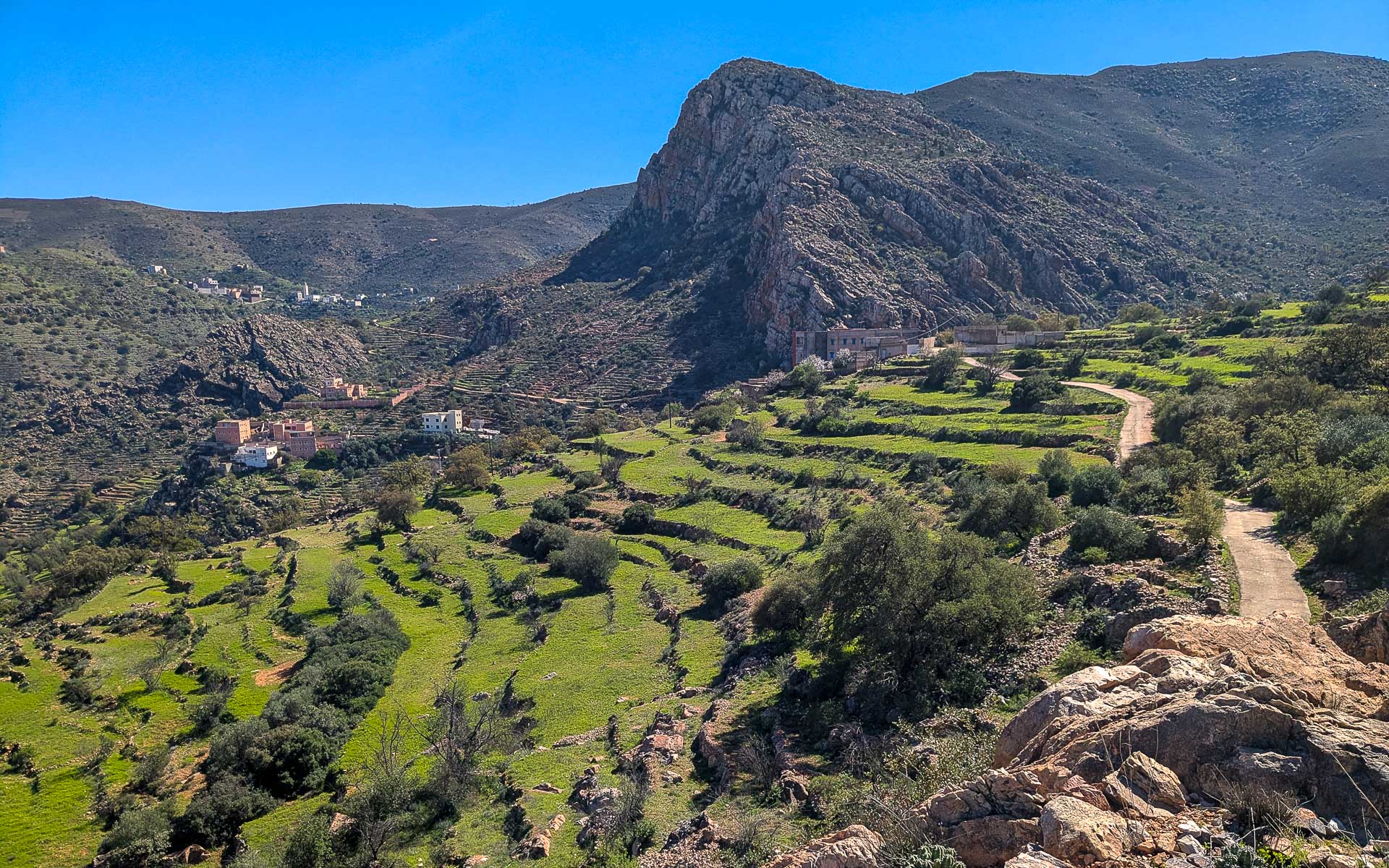
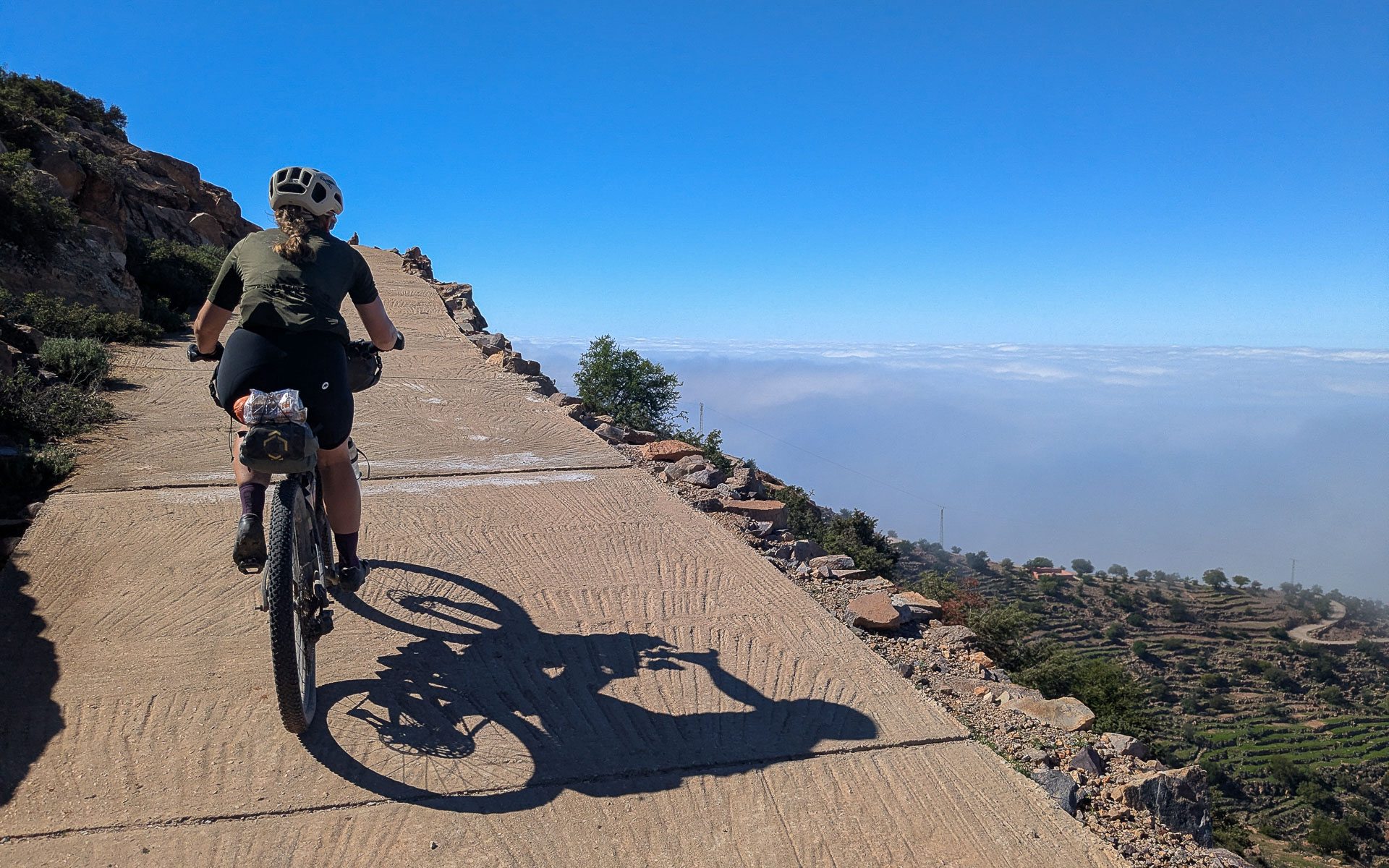
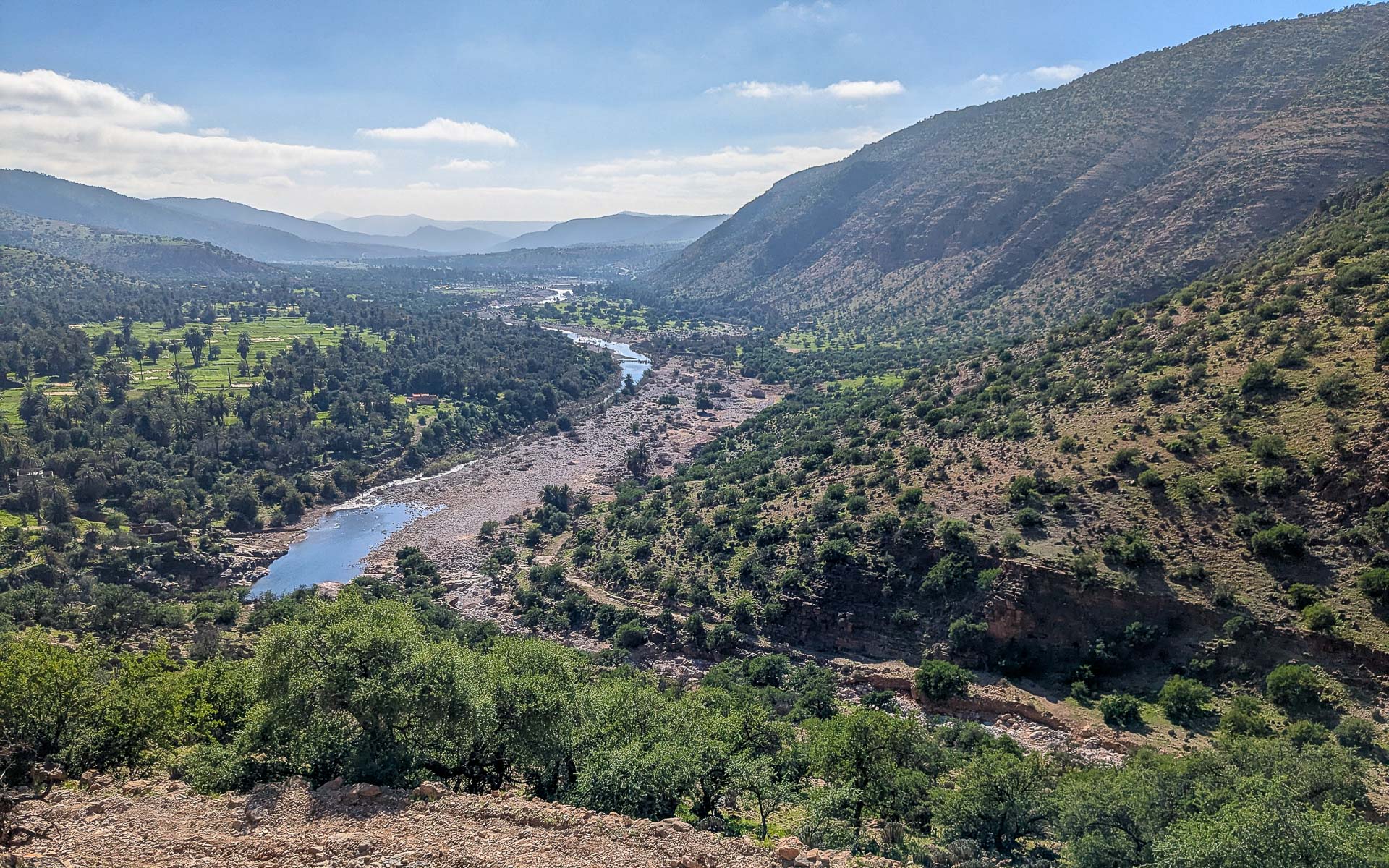
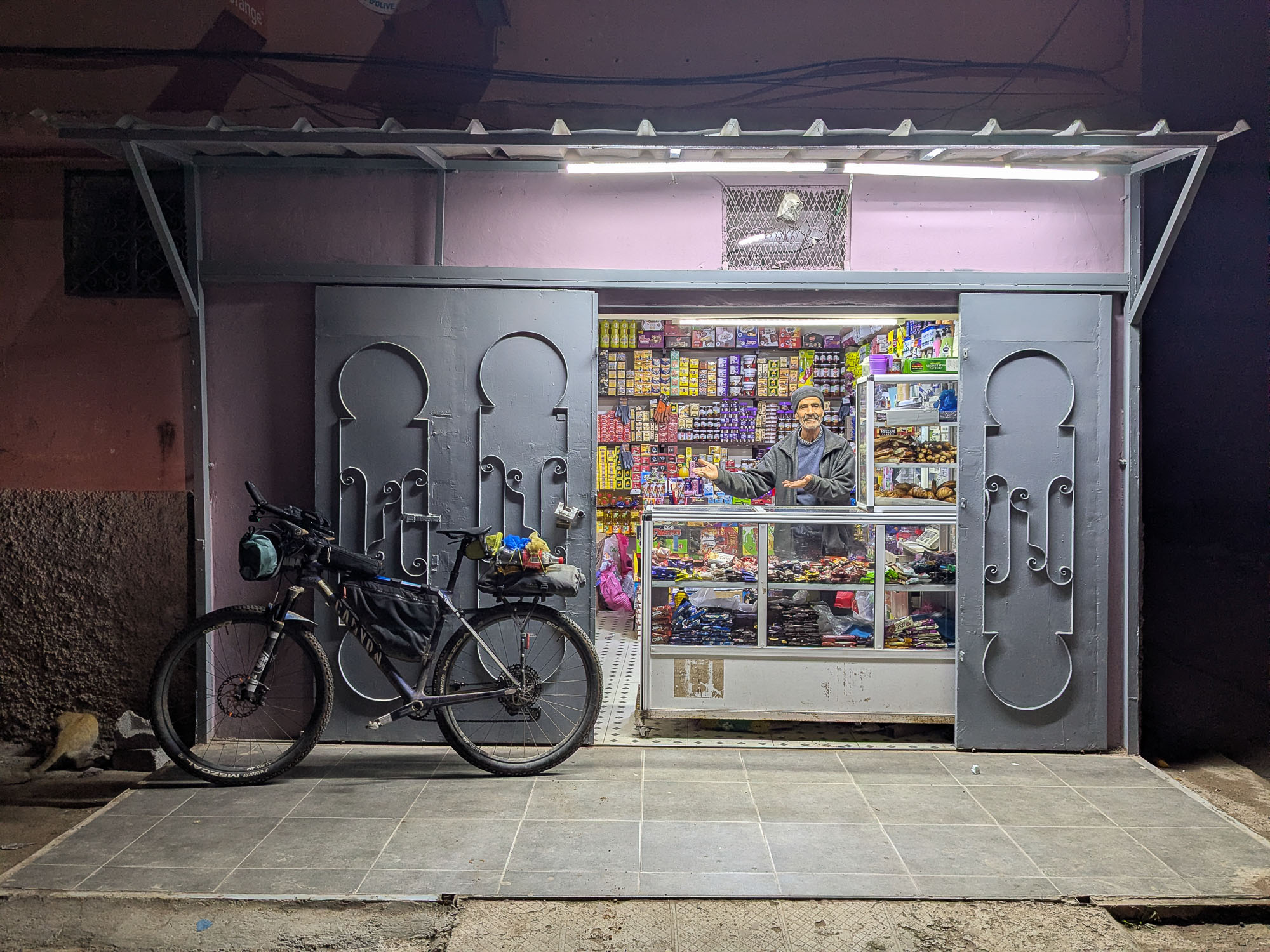
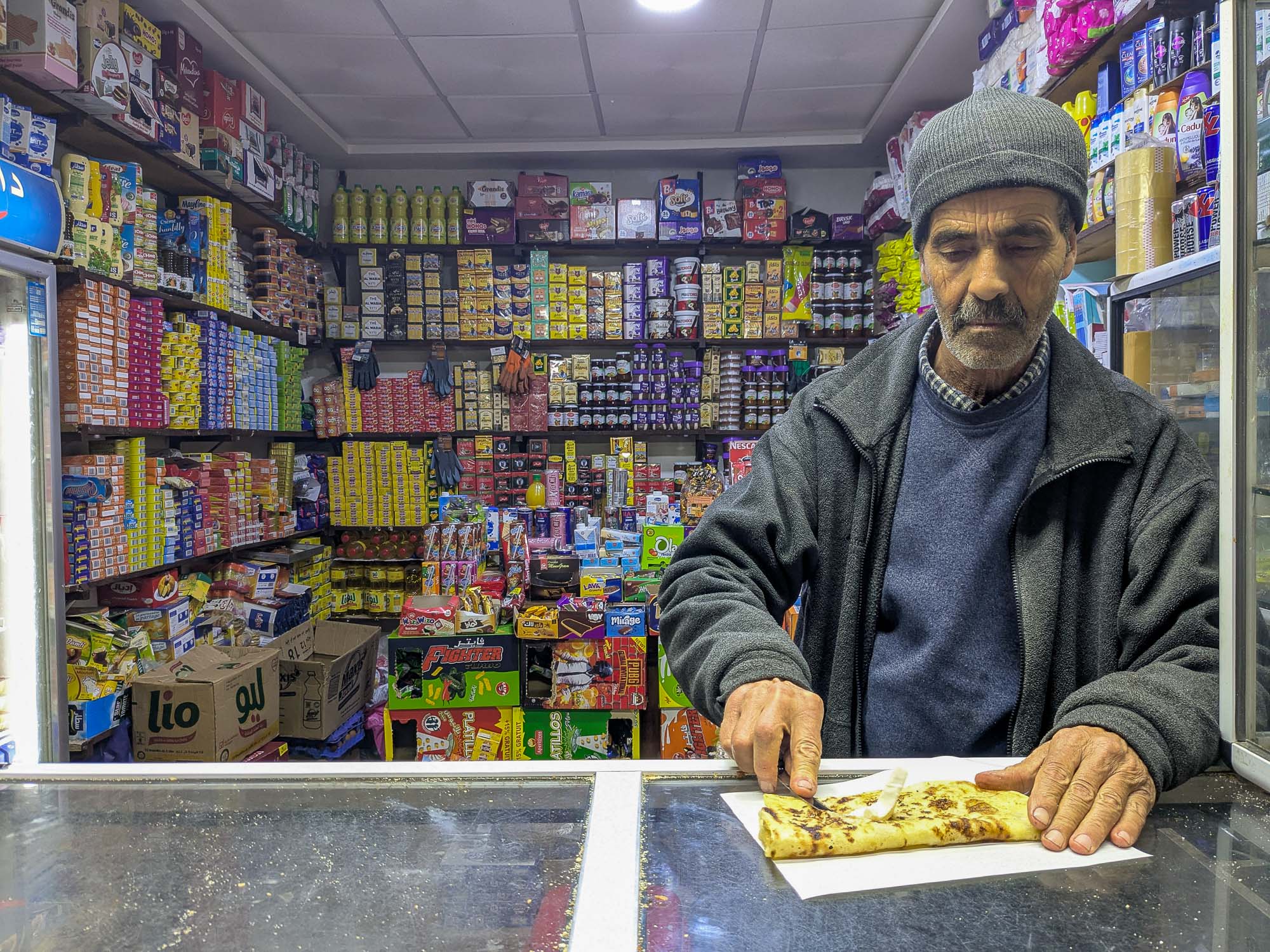
In the bustling town of Aït Baha, at kilometre 1120, around 8:30pm, I grab a quick bite to eat before setting off into the night, travelling alone. Some of the tracks are terrible and unrideable. Others are smooth as silk. I press on.
Around midnight, as a heavy drizzle soaks me from head to toe, the residents of the hamlet of Hussain Ou Ali, at kilometre 1158, open a room in the mosque for me to take shelter for a few hours. Another participant, Eoin from Ireland, joins me, happy to find this unexpected refuge. We’re right at the start of the 18-kilometre stretch of sandy track, one of the race’s toughest sections. The kind of place where you might find yourself pushing your bike for 3 or 4 hours. But first we take a break.
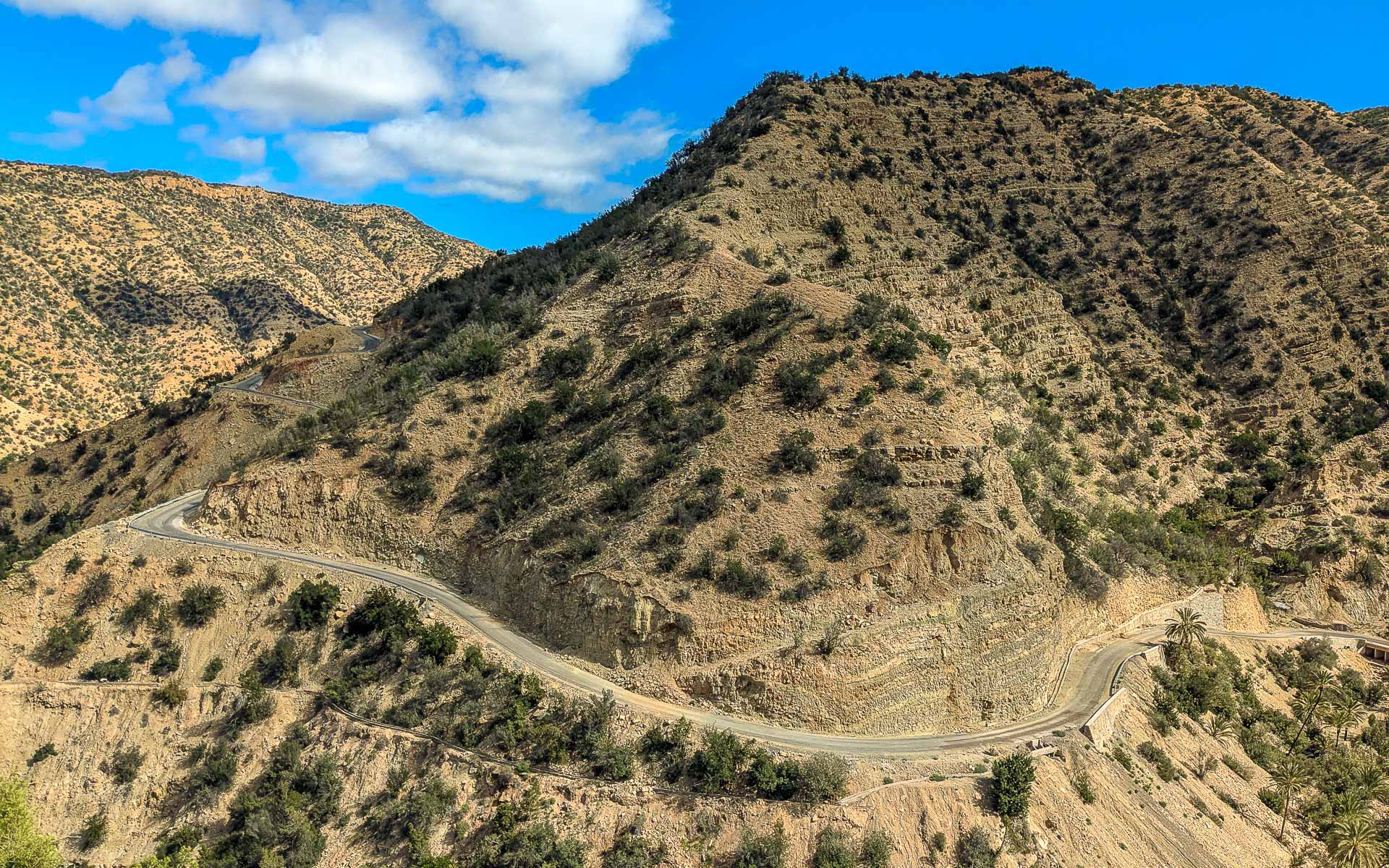
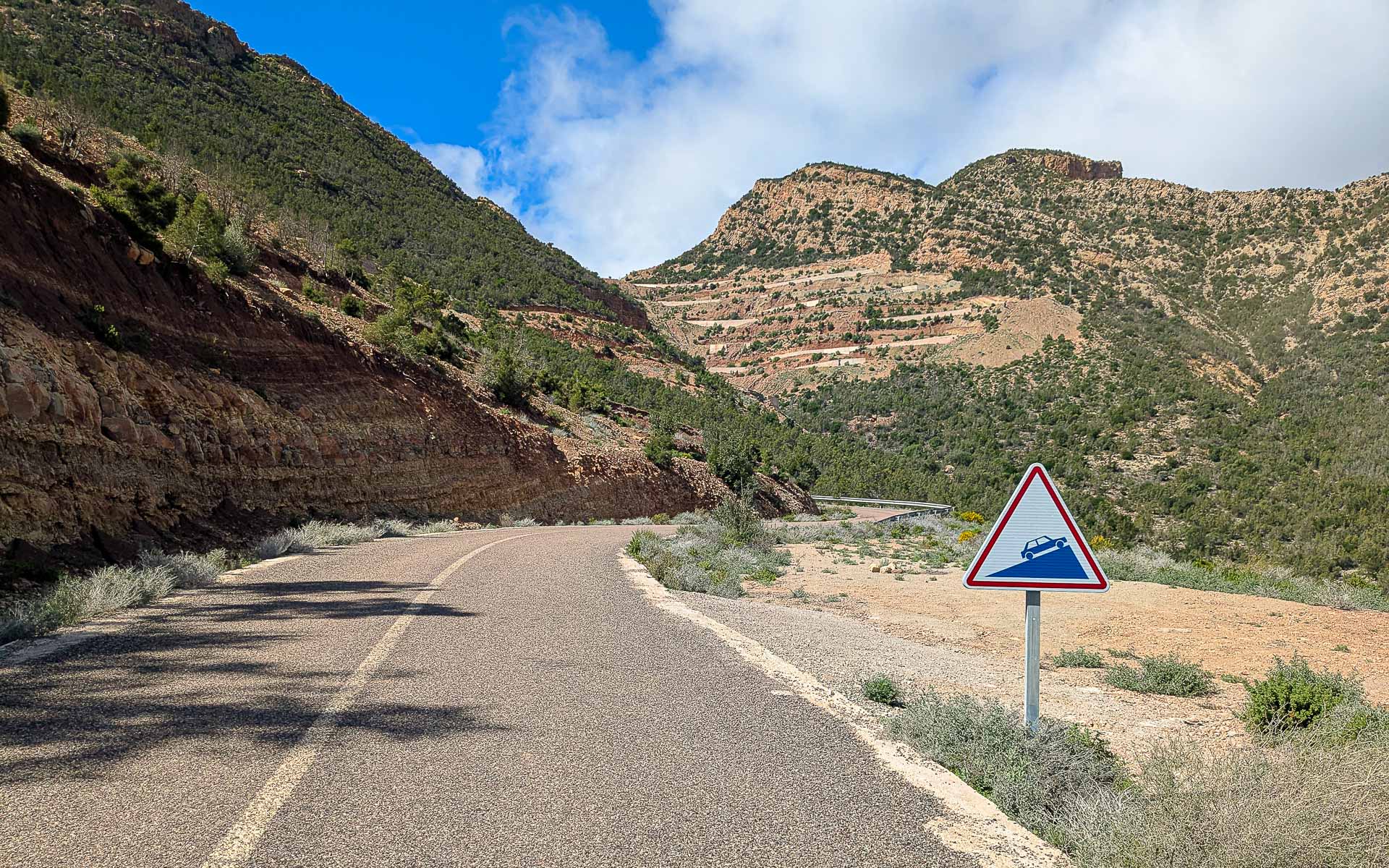
At 4:50am, I tackle the sandy section, ready to suffer. But thanks to the previous night’s drizzle, the sand has hardened. I get through the section in an hour. A miracle! Miracles are always welcome. Further on, I head toward the famous Moroccan version of the Stelvio Pass, which borrows a beautiful series of hairpin turns from its Italian counterpart. Up there, at an altitude of about 1,100 metres, it’s wind and drizzle—a welcome sight after three days in the scorching desert.
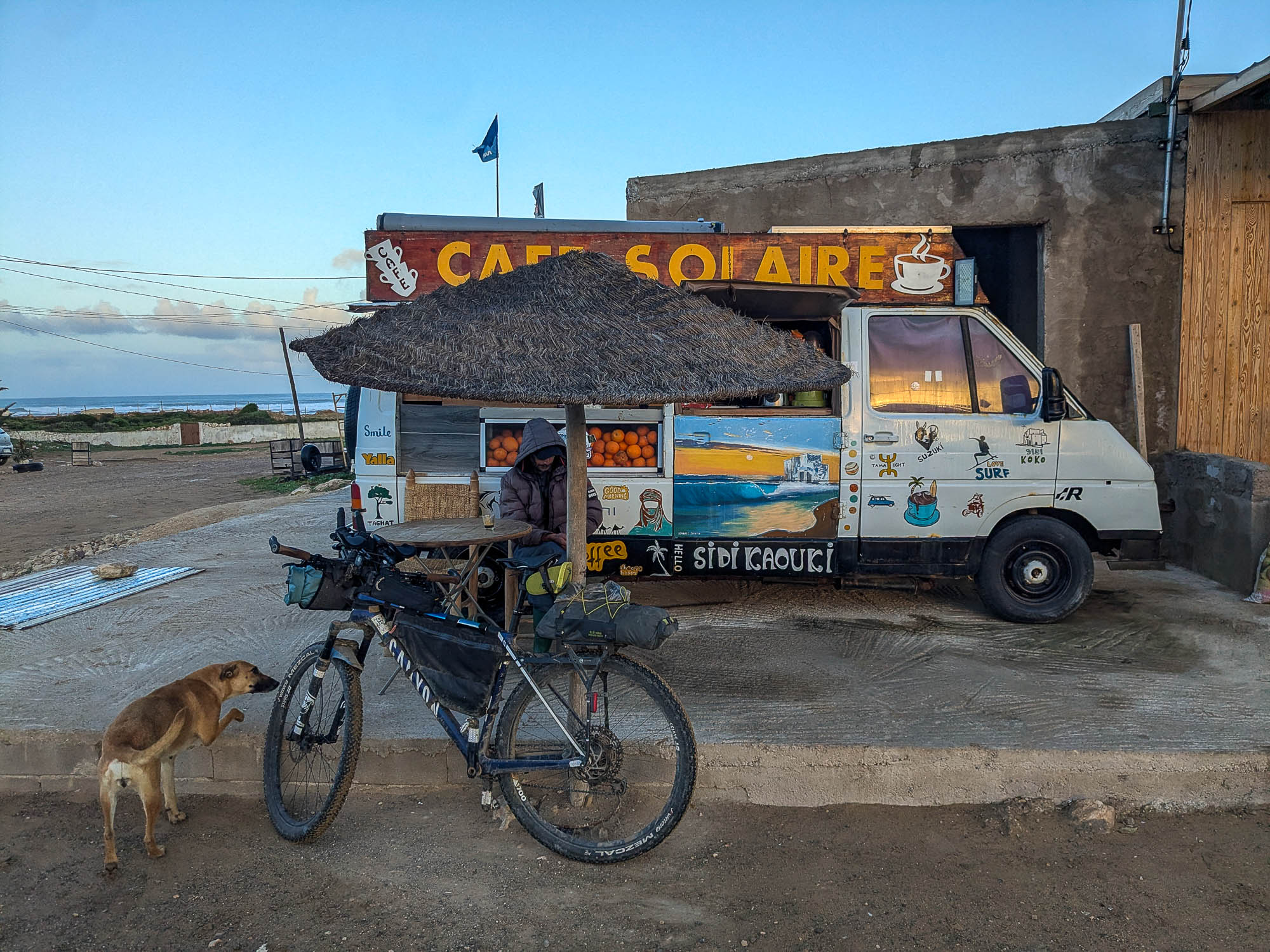
At two or three strategic points along the route—such as mountain passes or long stretches with no places to restock—locals have parked their cars, loaded with food and drinks. A table, a few plastic chairs. Mobile oases. Unexpected, but very welcome. The hospitality of the local people—whether in the villages, at the checkpoints, or at these impromptu aid stations—clearly saved the race for me.


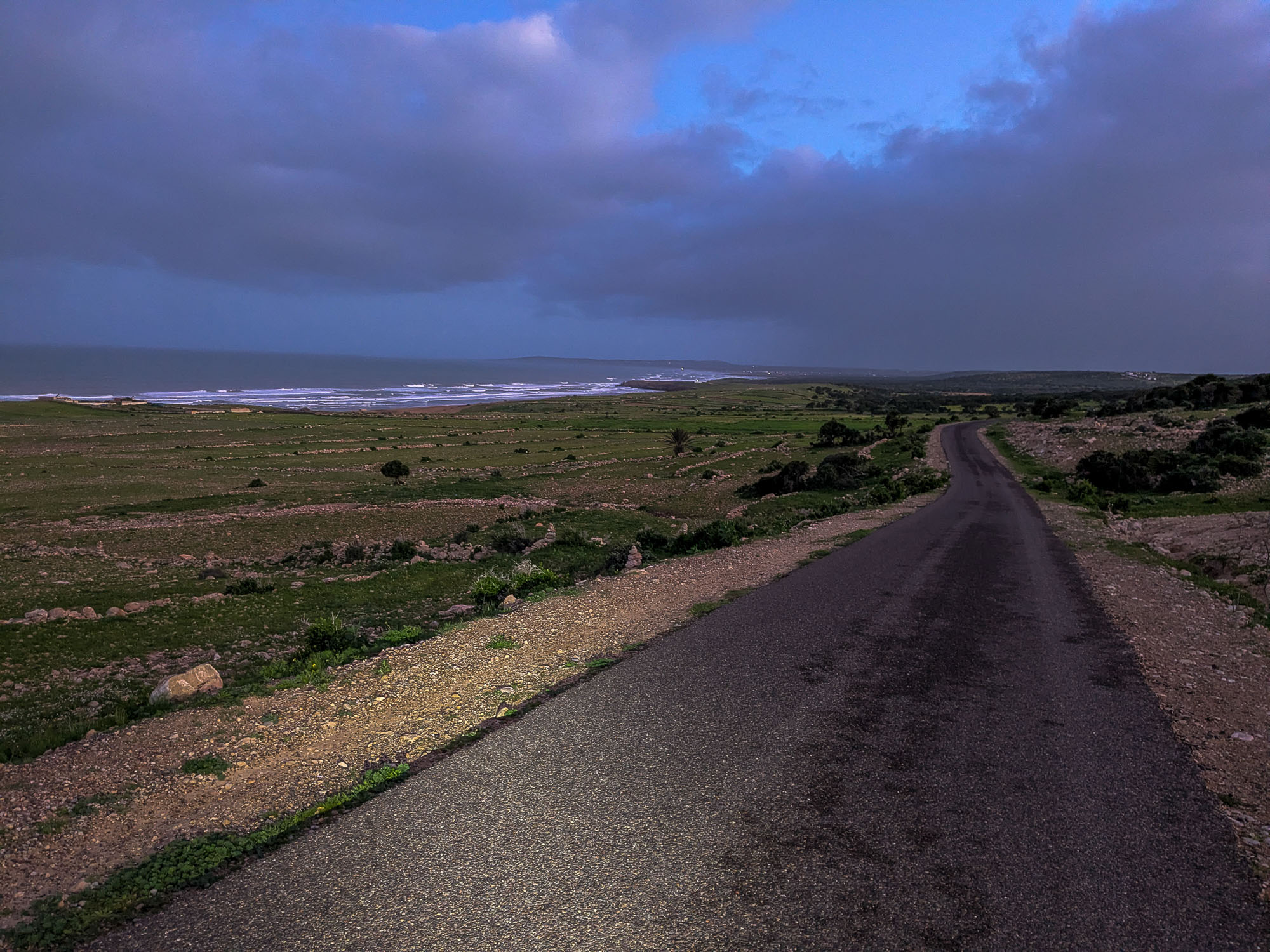
Little by little, after pedalling for hours and hours and hours on deserted roads and bumpy trails, I reach the Atlantic coast around 10pm, in the village of Imsouane, at kilometre 1344. I set up camp in the spartan room of a small lodge. The scent of the sea, carried by the ocean breeze, fills the air. Thanks to the nearby bakery, which is still open at 10pm, I pile up a veritable feast on the small wooden table in the room: two pastries—one chocolate and one with red berries—500 ml of Greek yogurt, half a litre of Orangina, 1.5 litres of water, bread, La Vache Qui Rit cheese, and tuna in tomato sauce. A feast. Four hours later, at 3:40am, I set out on the final 93 kilometres to Essaouira.
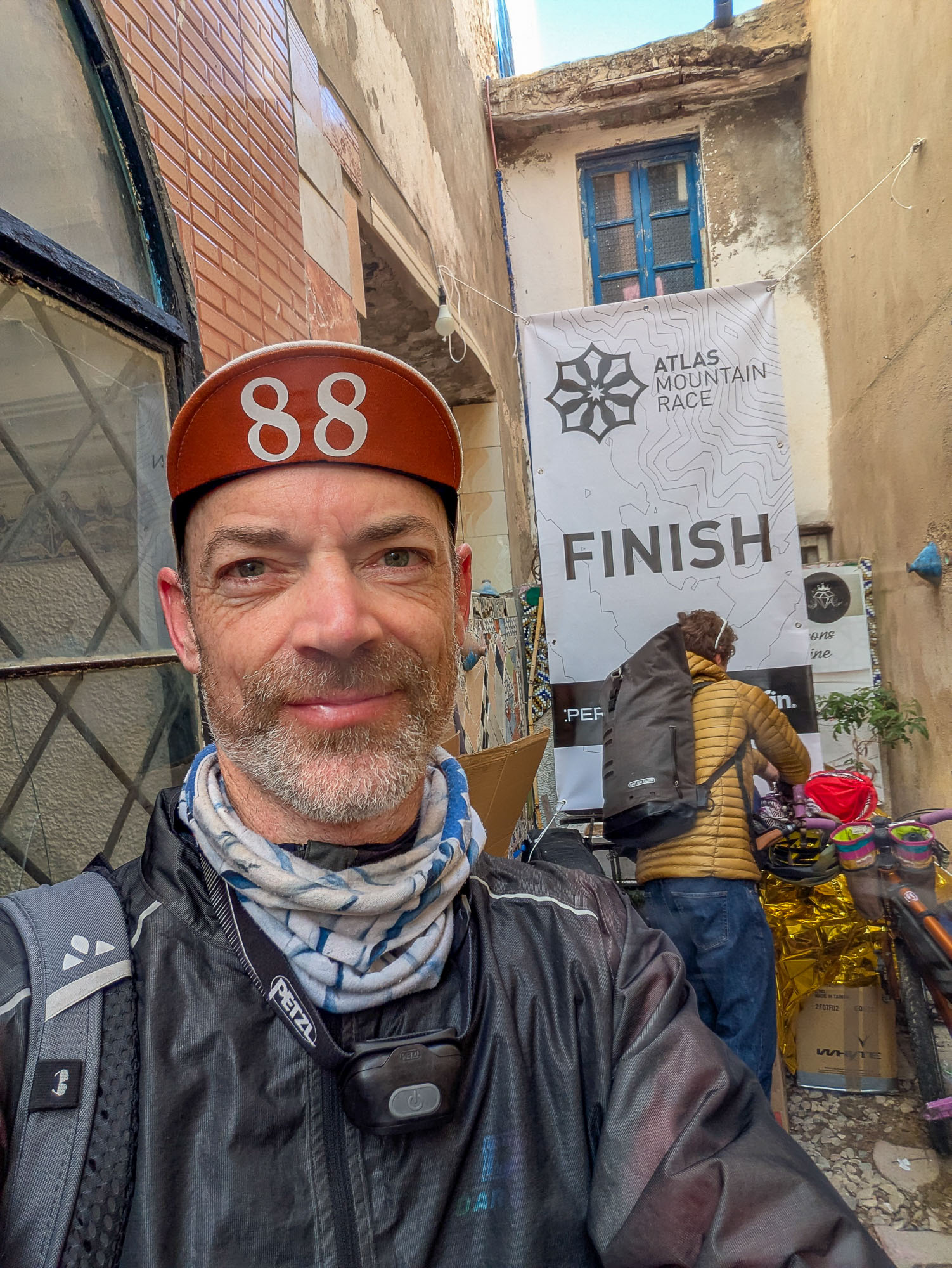
As soon as I walk through the lodge door, I see two black shadows pass in front of me, like the Nazgûls from Lord of the Rings. They’re no longer just participants—they’re competitors. I get caught up in the race’s intensity during the final kilometres. I pass them on the first climb and don’t see them again—only the light from their headlamps. On autopilot, in the dead of night, the race’s final starry sky, the last headwind, coffee and orange juice at dawn on a beach, and then the emotional finish at the fortified gate of Essaouira, kilometre 1,438.
A hug with the volunteers, and a stamp on the finish card.
I’ve made it.



epilogue
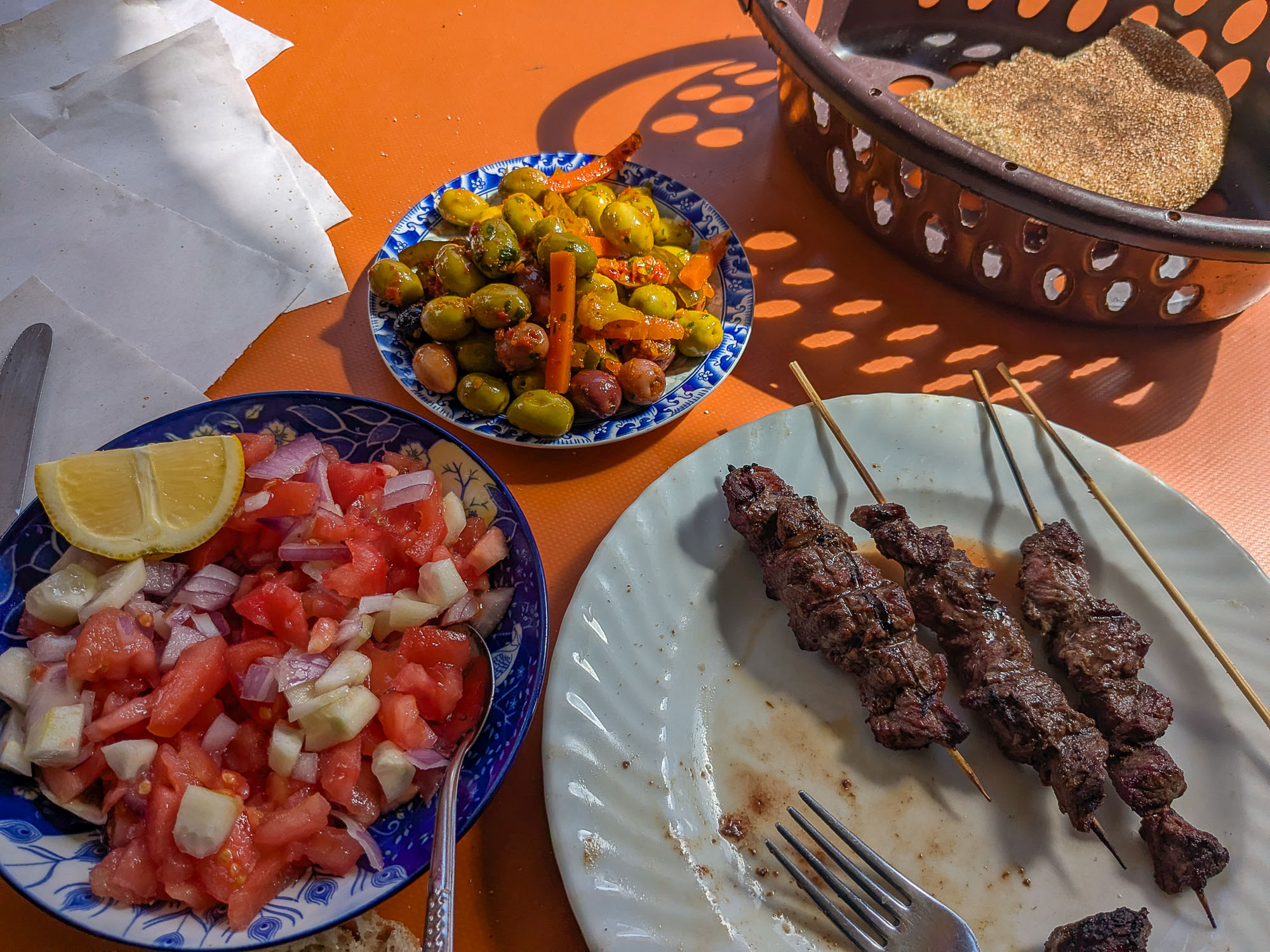
Essaouira is the perfect place to finish a bike ride. The finish line is easy to find. Beyond it lies the endless blue of the Atlantic Ocean. An hour after finishing, with my bike parked at the Maison du Vent—a quiet riad in the heart of the small medina—I sat for a long time under the arched walkways of the main street, watching the world go by. I went for a walk along the harbour, crowded with hundreds of blue boats, and did some shopping at the fish market. I bought squid and sea bream, paid a guy to prepare them for me, and another to grill them. I ordered a Moroccan salad, fries, and a Coke. I was happy. I had the satisfaction of having seen something through to the end without really understanding how I’d managed it. I think that’s what I love about these trips. The unexpected, the discovery. I know why I came. For the adventure, for the country, for the long days on the bike, the desert, the mountains, the camaraderie along the trail. But I’m leaving with something else. A very deep sense of accomplishment, the surprise of having found the strength to carry on just when I was about to give up. All mixed with a general weariness that keeps me in a pleasant daze. The AMR is just cycling, but it’s also a gateway to discovering profound things we didn’t know were within us.